Guide 06
Cook County judicial sales, from the judgment to the deed
13 min read · updated November 16, 2026
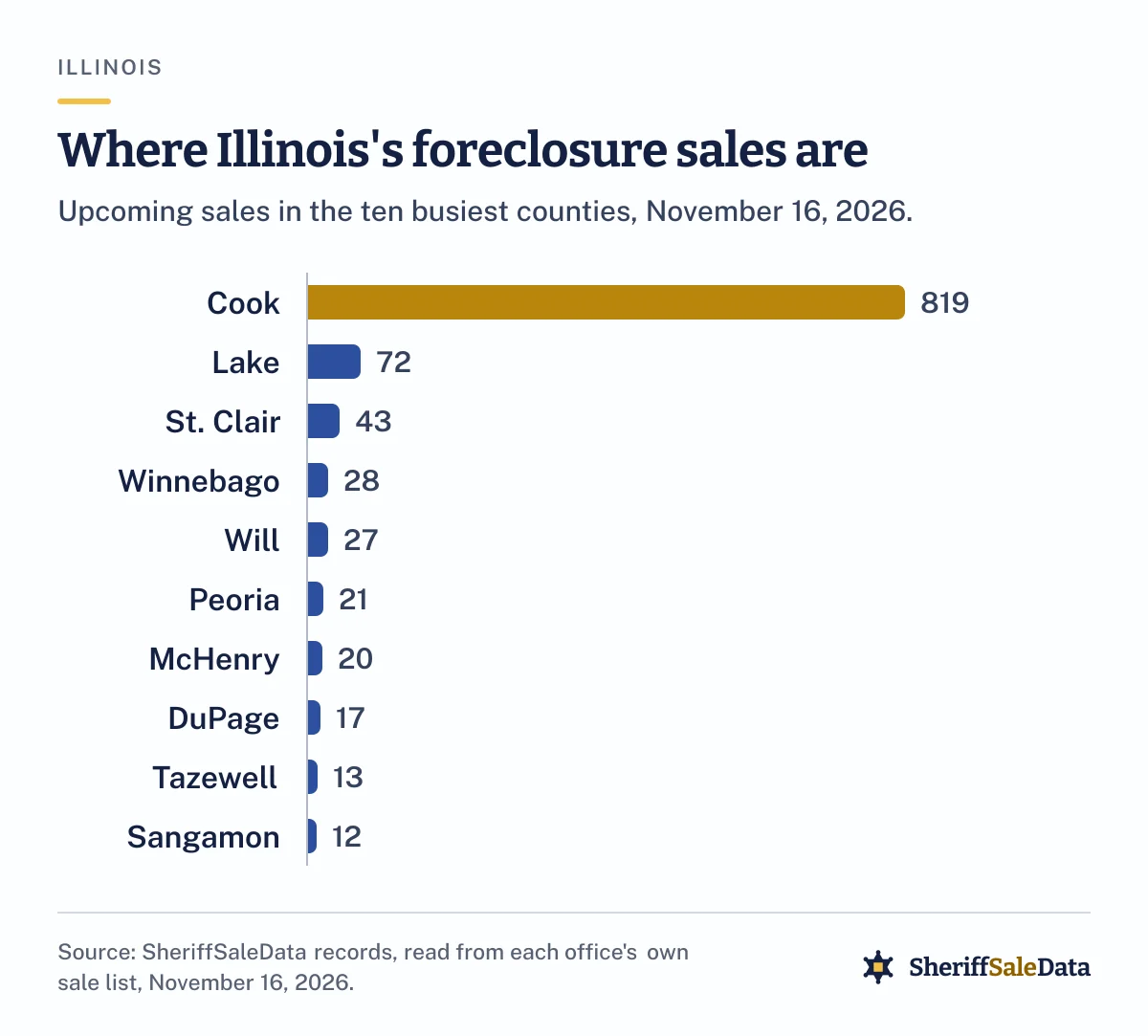
Cook County has more foreclosure sales on its lists than any other county in Illinois. Our records hold 778 upcoming Cook County sheriff sales. The next is on November 17, 2026, and 13 of them have already been postponed at least once. They are not sheriff sales in the usual sense. Illinois calls them judicial sales, the judgment of foreclosure names who will hold each one, and in Cook that is a private company the court appoints. This guide takes a Cook sale in the order a bidder meets it; the rest of the state is on the Illinois sale lists.
Who sells: the court's selling officer
In Illinois the judgment of foreclosure names the officer who sells the property. In Cook County that is not the sheriff but a private selling officer the court appoints: it holds the auction, and the plaintiff's attorney prepares the papers.
The Illinois Mortgage Foreclosure Law lets the court choose: "A sale may be conducted by any judge, sheriff, or other person" the judgment designates [1], and the judgment can name "an official or other person who shall be the officer to conduct the sale other than the one customarily designated by the court" [2]. Cook County's chancery rules require that "All judgments in Chancery directing sale of real estate shall designate a selling official to conduct such sale" [3], and speak of sales "conducted by a private sales corporation pursuant to court order" [4]. In practice two such companies hold nearly all of Cook's mortgage foreclosure sales, each with its own list, its own start time and its own deposit rule. In many other Illinois counties the sheriff still sells.
That has two practical consequences. First, in Cook "the attorney for the plaintiff, unless otherwise directed, shall prepare the appropriate documents" for the sale [5]: the notice, the report of sale, the certificate of sale and the deed. The plaintiff's firm, printed on every listing, is the place to ask about a case. Second, every foreclosure is a case in the Chancery Division, whose Mortgage Foreclosure Section "consists of Calendars 56 - 64" [6], and the case number on the listing opens its docket.
Before the sale: reinstatement and redemption
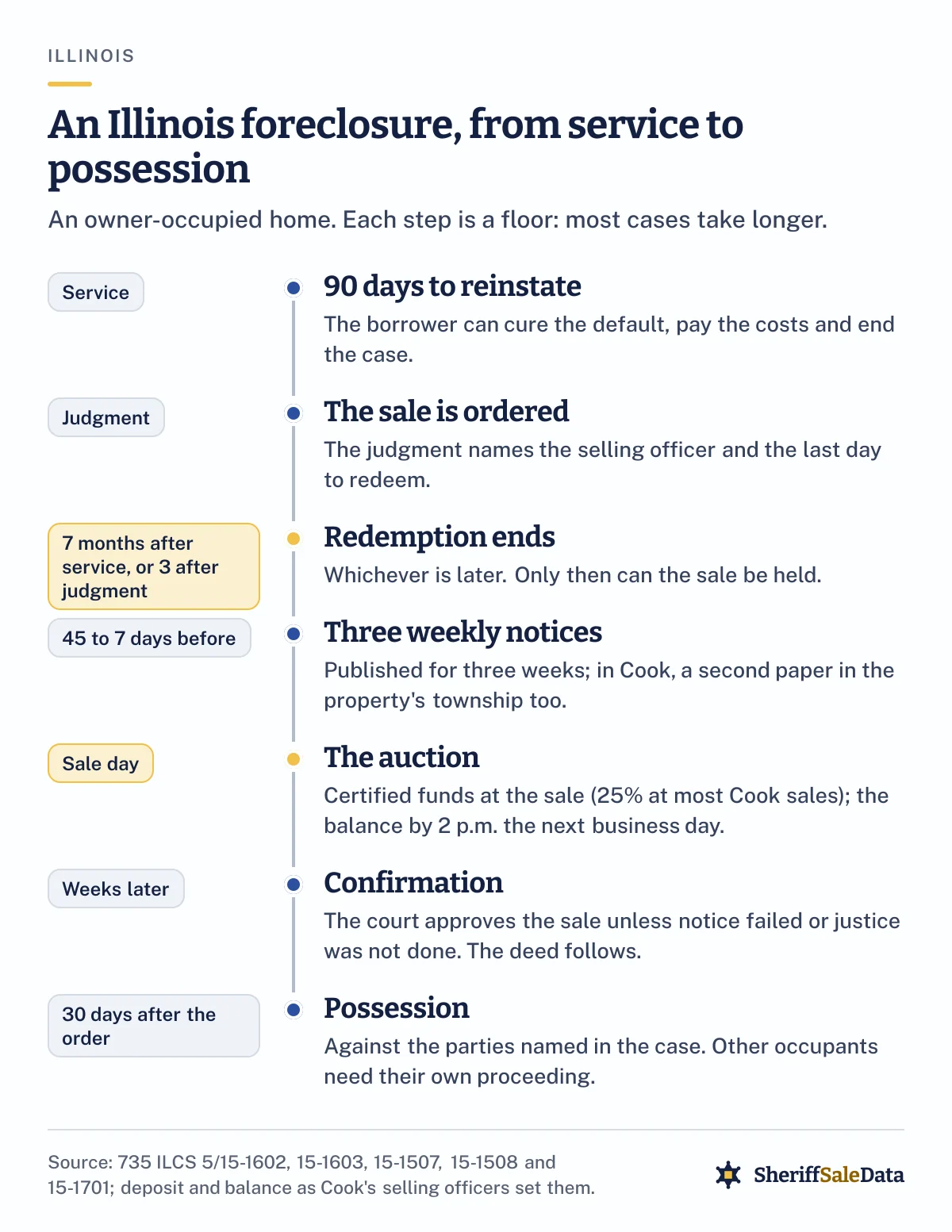
An Illinois foreclosure sale is held only after the owner's reinstatement and redemption periods have ended. For an owner-occupied home, redemption runs to the later of seven months after the owners were served or three months after the judgment.
The owner has two ways to keep the property before any sale. Reinstatement: the borrower can cure the default and pay the costs, ending the case, "provided that such cure and payment are made prior to the expiration of 90 days from the date the mortgagor" was served [7]. Redemption: the owner can pay the whole judgment. For residential real estate, a home "for six or fewer families" lived in as a principal residence [8], "the redemption period shall end on the later of" seven months after the owners were served or "the date 3 months from the date of entry of a judgment of foreclosure" [9]. For other property it is six months from service or three from judgment [10], and if the court finds the property abandoned, redemption ends 30 days after judgment [11]. "A judgment of foreclosure shall include the last date for redemption" [12], so the docket tells you the day.
The sale follows "upon expiration of the reinstatement period and the redemption period" [13]. By the time a Cook property reaches a sale list, the owner's statutory right to pay the debt and keep it has usually run out. Most cases take far longer than the minimum: a contested case, a loan modification review or a bankruptcy can add months.
Cook adds a step for homeowners. Those served with a foreclosure summons "will have access to housing counseling and legal assistance at no charge" through the court's mediation program [14], and if a case is referred to mediation after judgment, "no sale will be conducted or approved until completion of the mediation" [15]. It is one reason a listed sale disappears.
The notice, and reading the sale list
The notice of sale gives a contact, the property's address and legal description, the time, place and terms of the sale, and "the case title, case number and the court in which the foreclosure was filed" [16]. It is published "at least 3 consecutive calendar weeks (Sunday through Saturday), once in each week, the first such notice to be published not more than 45 days prior to the sale, the last such notice to be published not less than 7 days prior to the sale" [17]. In Cook a second notice runs in a different newspaper, one "published in the township in which the real estate is located" [18]. Since 2025 the notice must also say "whether the sale will take place online, in person, or both" [19].
The selling officers' lists carry the same facts, a line per sale:
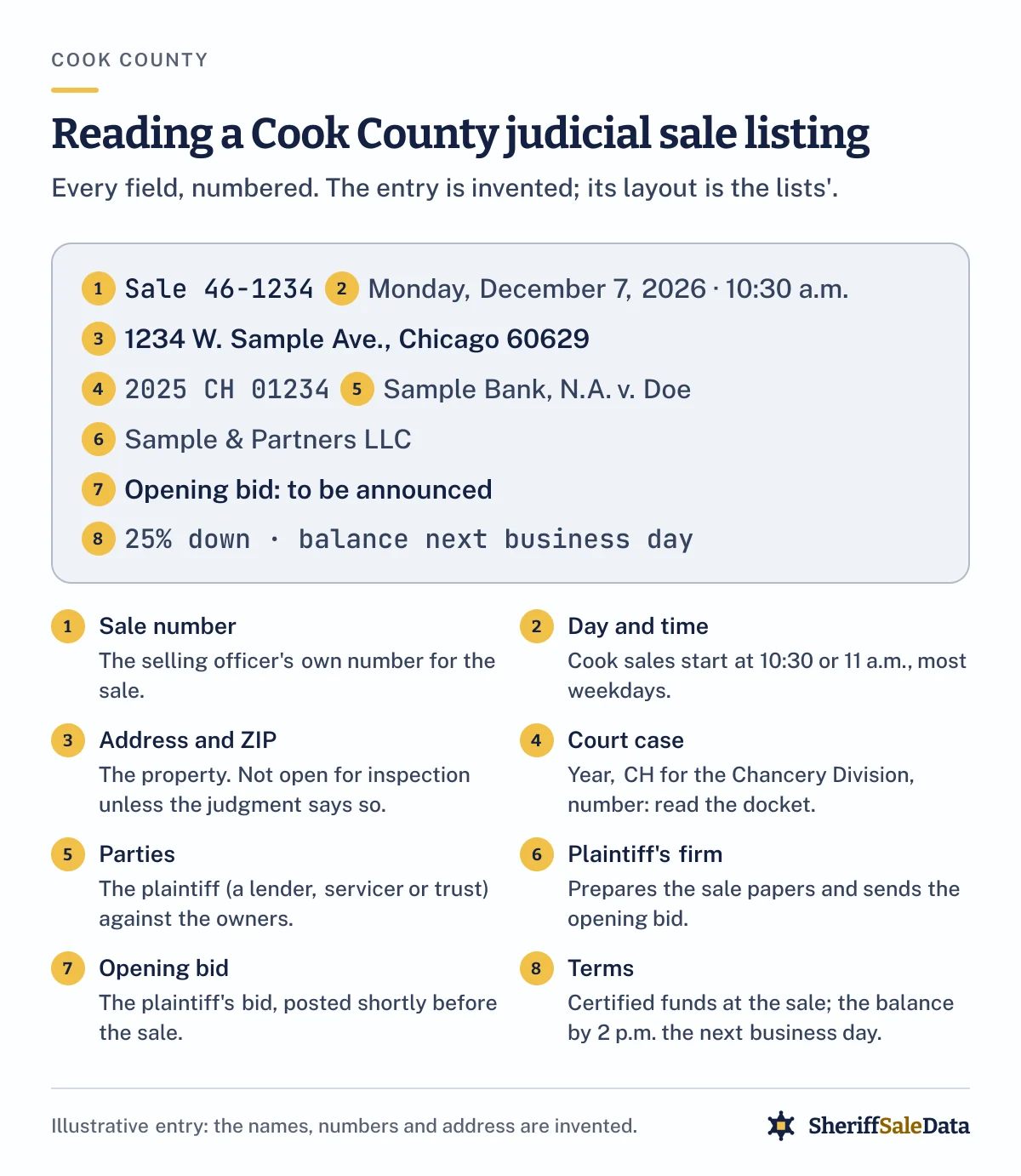
Dates move. A sale adjourned to a day "less than 60 days after the last scheduled sale" needs no new notice [20]; the officer "shall, upon adjournment, announce the date, time and place upon which the adjourned sale shall be held" [21]. Check the list again the morning of the sale.
The opening bid, and who usually wins
The plaintiff sets the opening bid, usually just before the sale, and can bid on credit against what it is owed. Most Cook properties go back to the plaintiff: in the 90 days to November 15, 2026, 51 of the 63 Cook auctions with a posted result did.
The lender needs no cash to buy at its own sale; its price can be "paid or credited as an offset" against the debt [22]. On the lists, the opening bid is blank until the plaintiff's attorney sends bidding instructions, shortly before the sale: on November 16, 2026, 607 of the 1,176 upcoming Illinois sales we hold still showed the opening bid as to be announced. That figure is the plaintiff's bid, and an outside bidder has to beat it.
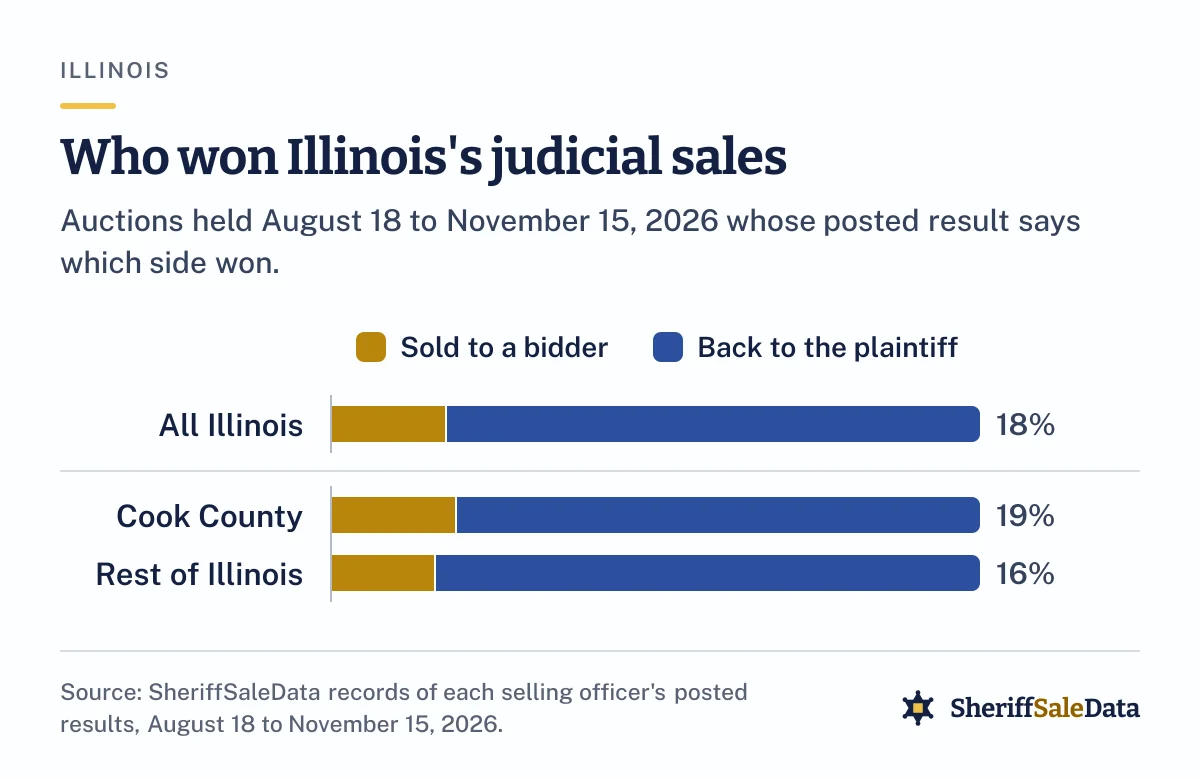
When the plaintiff bids close to what a property would fetch, no one outbids it, and it takes the property back to resell. The outside wins come where its opening bid sits well below the market, which is why the opening bid, once posted, matters more than anything printed weeks earlier.
At the sale: certified funds, and the balance the next day
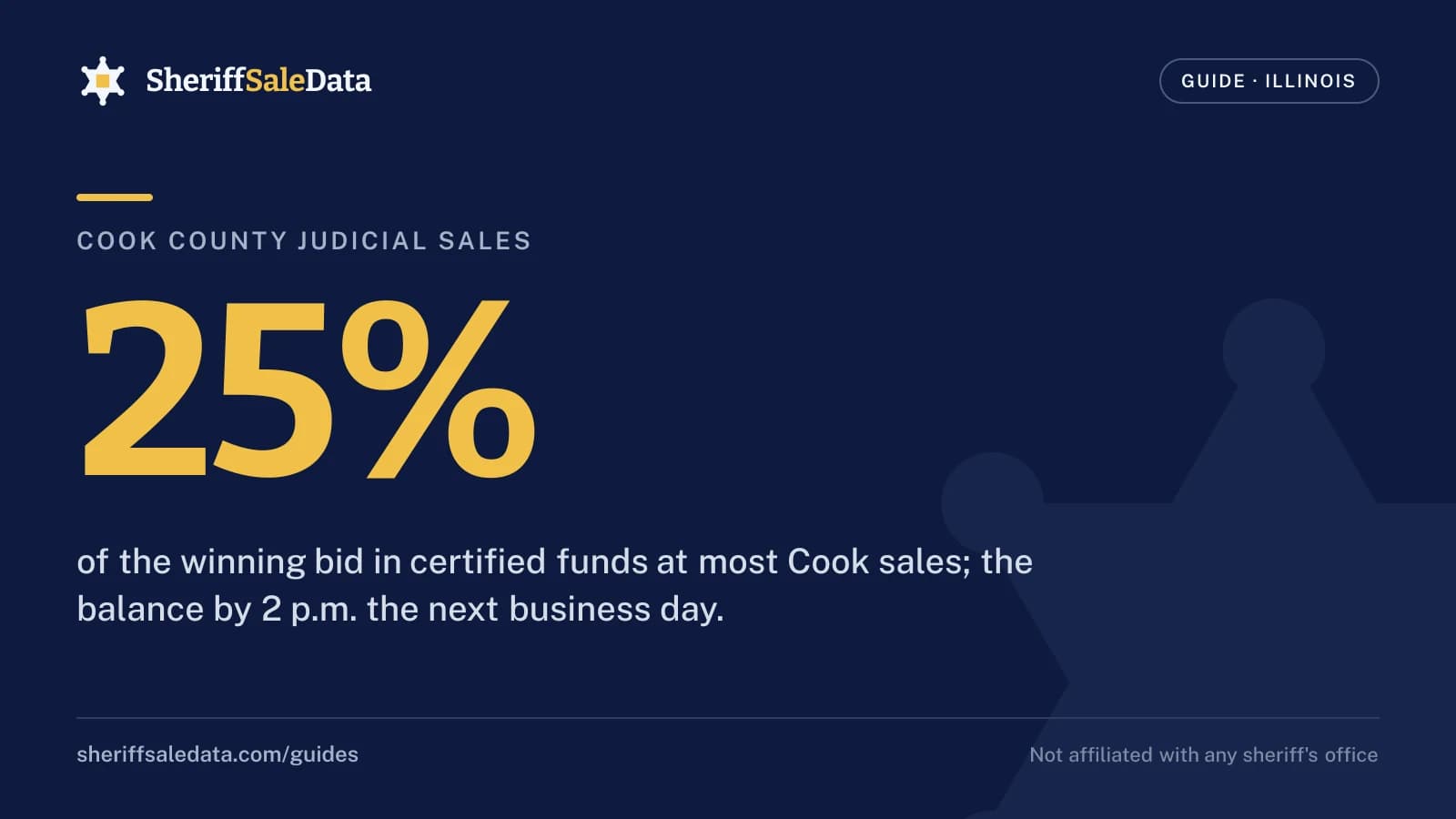
Most Cook sales ask 25 percent of the winning bid at the sale, in certified funds payable to the selling officer, and the balance by 2 p.m. the next business day. Since 2025, an outside buyer of residential property cannot be charged a buyer's premium or any other fee beyond the bid.
The statute leaves the terms to the court: the property is sold "on such terms and conditions as shall be specified by the court in the judgment of foreclosure" [23], at public auction unless the judgment orders "a manner of sale other than public auction" [24]. So each sale's terms are in its notice. Of the 614 upcoming Illinois sales whose listing prints a deposit, 604 ask 25 percent of the winning bid, 3 ask 10 percent and 7 the whole price; the other Cook officer's sales default to 10 percent unless the notice says otherwise. Either way the balance is due by 2 p.m. the next business day, in certified funds or by wire, and a buyer who misses it can forfeit the deposit.
At the door, expect to show government photo ID and to pay with certified or cashier's checks made out to the selling officer; third-party checks are refused. Some sale rooms register your funds and hand you a bid paddle, and you cannot bid past what you registered.
The winner gets a receipt that shows "the amount bid, the amount paid, the total amount paid to date and the amount still to be paid" [25], and "upon payment in full of the amount bid" a certificate of sale [26]. Any part of the price left unpaid carries "interest at the statutory judgment rate" until paid [27].
What a buyer does not pay: at a sale of residential real estate, "no fee, including a buyer's premium, may be charged to a third-party bidder or purchaser who is not a party to the case at the sale of real estate under this Article beyond the winning bid amount to cover an expense of conducting the sale" [28]. And "There shall be no fee charged to the public to view properties for sale online or to participate in any auction in person or online" [29].
The same 2025 law opened the door to online sales. The plaintiff "may request that the judge, sheriff, or other person conduct the sale either in person, online, or both, if available" [30]; online bidders must "have their identity verified through an identification verification process before a bid can be placed online" [31], the winner is checked against the federal sanctions list "before an order approving the sale may be entered" [32], and a residential sale "may be held open for bidding for up to 3 days" [33]. The notice says which kind of sale you are bidding at.
Confirmation, the certificate and the deed
A Cook judicial sale is final only once a judge confirms it, usually some weeks after the auction. The court must confirm unless notice was missing, the terms were unconscionable, the sale was fraudulent or justice was otherwise not done; the deed follows confirmation and payment.
After the auction "The person conducting the sale shall promptly make a report to the court" [34], and the plaintiff's attorney moves for an order approving the sale. The court confirms unless required notice was not given, "the terms of sale were unconscionable, (iii) the sale was conducted fraudulently, or (iv) justice was otherwise not done" [35]. A party who was owed notice and did not get it can ask to set the sale aside, but must "guarantee or secure by bond a bid equal to the successful bid at the prior sale" [36]. Until then the buyer holds a certificate that "shall further indicate that it is subject to confirmation by the court" [37], and that "shall be freely assignable by endorsement thereon" [38]. Confirmation can take weeks, sometimes months; if the court refuses, the deposit comes back as its order directs.
Once the sale is confirmed and paid, the buyer is owed a deed: the statute calls for the officer to "promptly execute a deed to the holder or purchaser sufficient to convey title" [39], but "such deed shall not be construed to contain any covenant on the part of the person executing it" [40]: a judicial deed warrants nothing. What it does is bar "all claims of parties to the foreclosure" [41]. A buyer who resells quickly should know that, until the time to appeal the confirmation has run, the next buyer "will not be deemed a bona fide purchaser unless and until such period expires without an appeal having been filed" [42]. The buyer records the deed and pays the transfer taxes; Illinois exempts a foreclosure deed only when it is issued "to a holder of a mortgage" [43], at a state rate of 50 cents per $500 [44], before the county's and Chicago's own.
Redemption after the sale. In general there is none: "No equitable right of redemption shall exist or be enforceable under or with respect to a mortgage after a judicial sale" [45]. The exception applies only when "the purchaser at the sale was a mortgagee who was a party to the foreclosure or its nominee" and the price was below the amount needed to redeem [46]. Then the owner of a home "shall have a special right to redeem, for a period ending 30 days after the date the sale is confirmed" [47]. An outside buyer never faces it. Separately, the United States, if it held a junior lien, can redeem within a year, or 120 days for a tax lien [48].
What the buyer takes on
The sale ends the interests of everyone named in the case, but not property taxes, a lien senior to the foreclosed mortgage, or the interest of anyone left out. A condominium buyer also owes up to six months of the former owner's unpaid assessments.
The property is sold "subject to (i) the interests of all other persons not made a party or (ii) interests in the mortgaged real estate not otherwise barred or terminated in the foreclosure" [49], a senior mortgage among them when a junior lien was foreclosed. Property taxes are "a prior and first lien on the property, superior to all other liens and encumbrances" [50], and taxes already sold at a tax sale can still be redeemed by "any owner or person interested in that property" [51], at a price: check the county's records for sold taxes before you bid. A city's lien for demolishing, repairing or boarding up an unsafe building is "superior to all prior existing liens and encumbrances, except taxes" when recorded in time [52]. A federal tax lien survives a sale the United States was not made a party to [53].
For a condominium unit, the buyer pays the common expenses "from and after the first day of the month after the date of the judicial foreclosure sale" [54]. A buyer other than the lender also owes the regular assessments that "would have become due in the absence of any assessment acceleration during the 6 months immediately preceding institution of an action to enforce the collection of assessments" [55], and the association's legal fees; the notice of sale must say so [56]. Units in a common interest community carry the same six months [57].
Possession: 30 days after the order
The order confirming the sale gives the buyer possession 30 days after it is entered, against the parties to the case. Anyone else in the property, a tenant included, needs a proceeding of their own, and a bona fide lease survives the sale.
The confirmation order includes "an award to the purchaser of possession of the mortgaged real estate, as of the date 30 days after the entry of the order" [58], and from that date the buyer "shall be entitled to possession" without a further order [59]. It "shall be entered and enforced only against those persons personally named as individuals" in the case [60]. For everyone else the buyer "shall not be entitled to proceed against any such occupant under Article IX of this Code until after 30 days after the order confirming the sale is entered" [61], or can, "up to 90 days after the date of the order confirming the sale, file a supplemental eviction petition" in the foreclosure [62]. A tenant current on rent can then stay "for 120 days following the notice of the hearing on the supplemental petition" [63], or to the end of the lease if sooner.
A judgment of foreclosure "does not terminate or otherwise affect a bona fide lease of a dwelling unit" [64], and federal law requires 90 days' notice to a bona fide tenant [65]. The buyer must also, "no later than 21 days after the order confirming sale, notify all known occupants" in writing [66], and until it does it "may not collect any rent due and owing from a known occupant" [67]. In Chicago, buying a foreclosed rental building carries one more cost: under the City's Keep Chicago Renting ordinance the new owner must offer tenants a new lease, and "Tenants may reject the offer of a new rental agreement and still receive $10,600 in relocation assistance" [68].
Outside Cook County
The same statute governs every county; what changes is who sells. Outside Cook the judgment often names the sheriff, and the sale is held in the county where the property is, on the terms its notice prints. The deposit, the deadline for the balance and the start time can all differ from Cook's, so read each notice on its own.
A Cook County bidder's checklist
- Find the sale on the list, and note the case number, the sale number, the day and the start time.
- Read the case on the Clerk of the Circuit Court's docket: the judgment, who was named, the last day to redeem, and any bankruptcy or mediation.
- Check the property's taxes, including any sold at a tax sale, and order a title search. For a condominium, get the association's assessment figures.
- Look from the street. The notice lists inspection times only if "the times specified in the judgment, if any" allow one [69].
- Work out your maximum before the opening bid is posted; how to buy at a sheriff sale sets out the deductions.
- Bring the deposit, 25 or 10 percent of your top bid, in certified funds payable to the selling officer, with photo ID, and line up the balance for the next business day.
- Check the list on the morning of the sale for a continuance, a cancellation and the plaintiff's opening bid.
- After you win, follow the confirmation hearing, collect and record the deed, and serve the occupant notice within 21 days of confirmation.
The Cook County sale list has every upcoming sale with its day, time and deposit, the sheriff sale calendar has the dates across Illinois, and the foreclosing lenders pages show who is bringing the cases.
Sources
- [1]735 ILCS 5/15-1507(b)(1) — Illinois General Assembly“A sale may be conducted by any judge, sheriff, or other person as set forth in paragraph (3) of subsection (f) of Section 15-1506.”
- [2]735 ILCS 5/15-1506(f)(3) — Illinois General Assembly“an official or other person who shall be the officer to conduct the sale other than the one customarily designated by the court”
- [3]Circuit Court of Cook County Rule 7.1(a) — Circuit Court of Cook County“All judgments in Chancery directing sale of real estate shall designate a selling official to conduct such sale.”
- [4]Circuit Court of Cook County Rule 7.1(d)(ii) — Circuit Court of Cook County“conducted by a private sales corporation pursuant to court order, all such funds in the amount of $100.00 dollars or more are to be deposited by the private sales corporation with the Clerk of the Circuit Court”
- [5]Circuit Court of Cook County Rule 7.1(b) — Circuit Court of Cook County“the attorney for the plaintiff, unless otherwise directed, shall prepare the appropriate documents and otherwise aid the Court and the Court-appointed selling official in carrying out the sale”
- [6]Chancery Division, Mortgage Foreclosure Section — Circuit Court of Cook County“The Mortgage Foreclosure Section of the Chancery Division consists of Calendars 56 - 64.”
- [7]735 ILCS 5/15-1602 — Illinois General Assembly“provided that such cure and payment are made prior to the expiration of 90 days from the date the mortgagor”
- [8]735 ILCS 5/15-1219 — Illinois General Assembly“for six or fewer families living independently of each other, which residence, or at least one of which condominium or dwelling units, is occupied as a principal residence”
- [9]735 ILCS 5/15-1603(b)(1) — Illinois General Assembly“the redemption period shall end on the later of (i) the date 7 months from the date the mortgagor or, if more than one, all the mortgagors (A) have been served with summons or by publication or (B) have otherwise submitted to the jurisdiction of the court, or (ii) the date 3 months from the date of entry of a judgment of foreclosure”
- [10]735 ILCS 5/15-1603(b)(2) — Illinois General Assembly“the redemption period shall end on the later of (i) the date 6 months from the date the mortgagor”
- [11]735 ILCS 5/15-1603(b)(4) — Illinois General Assembly“the redemption period shall end on the date 30 days after the date the judgment of foreclosure is entered if the court finds that the mortgaged real estate has been abandoned”
- [12]735 ILCS 5/15-1506(e) — Illinois General Assembly“A judgment of foreclosure shall include the last date for redemption”
- [13]735 ILCS 5/15-1507(b)(1) — Illinois General Assembly“Upon expiration of the reinstatement period and the redemption period in accordance with subsection (b) or (c) of Section 15-1603”
- [14]Mortgage Foreclosure Mediation Program — Circuit Court of Cook County“homeowners who have received a summons to appear in court will have access to housing counseling and legal assistance at no charge”
- [15]Circuit Court of Cook County Rule 21.14(D)(8) — Circuit Court of Cook County“In the event a residential mortgage foreclosure case was referred to mediation after entry of the judgment of foreclosure, no sale will be conducted or approved until completion of the mediation.”
- [16]735 ILCS 5/15-1507(c)(1) — Illinois General Assembly“the case title, case number and the court in which the foreclosure was filed”
- [17]735 ILCS 5/15-1507(c)(2) — Illinois General Assembly“The notice of sale shall be published at least 3 consecutive calendar weeks (Sunday through Saturday), once in each week, the first such notice to be published not more than 45 days prior to the sale, the last such notice to be published not less than 7 days prior to the sale”
- [18]735 ILCS 5/15-1507(c)(2)(i)(B) — Illinois General Assembly“the newspaper in which the notice required by this item (B) is published shall be a newspaper published in the township in which the real estate is located”
- [19]735 ILCS 5/15-1507(c)(1)(F) — Illinois General Assembly“whether the sale will take place online, in person, or both”
- [20]735 ILCS 5/15-1507(c)(4) — Illinois General Assembly“if the adjourned sale is to occur less than 60 days after the last scheduled sale, notice of any adjourned sale need not be given pursuant to this Section”
- [21]735 ILCS 5/15-1507(c)(4) — Illinois General Assembly“the person conducting the sale shall, upon adjournment, announce the date, time and place upon which the adjourned sale shall be held”
- [22]735 ILCS 5/15-1604(a) — Illinois General Assembly“from the date the purchase price was paid or credited as an offset”
- [23]735 ILCS 5/15-1507(b)(1) — Illinois General Assembly“the real estate shall be sold at a sale as provided in this Article, on such terms and conditions as shall be specified by the court in the judgment of foreclosure”
- [24]735 ILCS 5/15-1506(f)(1)-(2) — Illinois General Assembly“a manner of sale other than public auction”
- [25]735 ILCS 5/15-1507(e) — Illinois General Assembly“The receipt shall describe the real estate purchased and shall show the amount bid, the amount paid, the total amount paid to date and the amount still to be paid therefor.”
- [26]735 ILCS 5/15-1507(f) — Illinois General Assembly“Upon payment in full of the amount bid, the person conducting the sale shall issue, in duplicate, and give to the purchaser a Certificate of Sale.”
- [27]735 ILCS 5/15-1507(g) — Illinois General Assembly“interest at the statutory judgment rate on any unpaid portion of the sale price from the date of sale to the date of payment”
- [29]735 ILCS 5/15-1507.2(h) — Illinois General Assembly“There shall be no fee charged to the public to view properties for sale online or to participate in any auction in person or online.”
- [30]735 ILCS 5/15-1507(b)(2) — Illinois General Assembly“may request that the judge, sheriff, or other person conduct the sale either in person, online, or both, if available”
- [31]735 ILCS 5/15-1507.2(j), (m) — Illinois General Assembly“require all bidders who wish to participate in bidding online to have their identity verified through an identification verification process before a bid can be placed online”
- [32]735 ILCS 5/15-1507.2(n)(1) — Illinois General Assembly“The person conducting the sale shall check the winning purchaser against the sanction list before an order approving the sale may be entered.”
- [33]735 ILCS 5/15-1507.2(q) — Illinois General Assembly“the sale may be held open for bidding for up to 3 days and extended by the person conducting the sale as needed to allow for all active competitive bidding to occur”
- [34]735 ILCS 5/15-1508(a) — Illinois General Assembly“The person conducting the sale shall promptly make a report to the court”
- [35]735 ILCS 5/15-1508(b) — Illinois General Assembly“the terms of sale were unconscionable, (iii) the sale was conducted fraudulently, or (iv) justice was otherwise not done, the court shall then enter an order confirming the sale”
- [36]735 ILCS 5/15-1508(c) — Illinois General Assembly“Any such party shall guarantee or secure by bond a bid equal to the successful bid at the prior sale”
- [37]735 ILCS 5/15-1507(f) — Illinois General Assembly“The Certificate of Sale shall further indicate that it is subject to confirmation by the court.”
- [38]735 ILCS 5/15-1507(f) — Illinois General Assembly“The Certificate of Sale shall be freely assignable by endorsement thereon.”
- [39]735 ILCS 5/15-1509(a) — Illinois General Assembly“promptly execute a deed to the holder or purchaser sufficient to convey title”
- [40]735 ILCS 5/15-1509(a) — Illinois General Assembly“but such deed shall not be construed to contain any covenant on the part of the person executing it”
- [41]735 ILCS 5/15-1509(c) — Illinois General Assembly“shall be an entire bar of (i) all claims of parties to the foreclosure”
- [42]735 ILCS 5/15-1509(a) — Illinois General Assembly“that other party will not be deemed a bona fide purchaser unless and until such period expires without an appeal having been filed”
- [43]35 ILCS 200/31-45(l) — Illinois General Assembly“Deeds issued to a holder of a mortgage, as defined in Section 15-103 of the Code of Civil Procedure, pursuant to a mortgage foreclosure proceeding”
- [44]35 ILCS 200/31-10 — Illinois General Assembly“for each $500 of value or fraction of $500 stated in the declaration required by Section 31-25”
- [45]735 ILCS 5/15-1605 — Illinois General Assembly“No equitable right of redemption shall exist or be enforceable under or with respect to a mortgage after a judicial sale of the mortgaged real estate pursuant to Section 15-1507”
- [46]735 ILCS 5/15-1604(a) — Illinois General Assembly“the purchaser at the sale was a mortgagee who was a party to the foreclosure or its nominee and (ii) the sale price was less than the amount specified in subsection (d) of Section 15-1603”
- [47]735 ILCS 5/15-1604(a) — Illinois General Assembly“shall have a special right to redeem, for a period ending 30 days after the date the sale is confirmed”
- [48]28 U.S.C. § 2410(c) — United States Congress“Where a sale of real estate is made to satisfy a lien prior to that of the United States, the United States shall have one year from the date of sale within which to redeem, except that with respect to a lien arising under the internal revenue laws the period shall be 120 days or the period allowable for redemption under State law, whichever is longer”
- [49]735 ILCS 5/15-1501(a) — Illinois General Assembly“any disposition of the mortgaged real estate shall be subject to (i) the interests of all other persons not made a party or (ii) interests in the mortgaged real estate not otherwise barred or terminated in the foreclosure”
- [50]35 ILCS 200/21-75 — Illinois General Assembly“shall be a prior and first lien on the property, superior to all other liens and encumbrances”
- [51]35 ILCS 200/21-345(a) — Illinois General Assembly“A right to redeem property from any sale under this Code shall exist in any owner or person interested in that property”
- [52]65 ILCS 5/11-31-1(a) — Illinois General Assembly“the lien is superior to all prior existing liens and encumbrances, except taxes, if, within 180 days after the repair, demolition, enclosure, or removal”
- [53]26 U.S.C. § 7425(a)(1) — United States Congress“shall be made subject to and without disturbing the lien of the United States, if notice of such lien has been filed in the place provided by law for such filing at the time such action or suit is commenced”
- [54]765 ILCS 605/9(g)(3) — Illinois General Assembly“shall have the duty to pay the unit's proportionate share of the common expenses for the unit assessed from and after the first day of the month after the date of the judicial foreclosure sale”
- [55]765 ILCS 605/9(g)(4) — Illinois General Assembly“the common expenses for the unit which would have become due in the absence of any assessment acceleration during the 6 months immediately preceding institution of an action to enforce the collection of assessments”
- [56]765 ILCS 605/9(g)(5) — Illinois General Assembly“shall state that the purchaser of the unit other than a mortgagee shall pay the assessments and the legal fees required by subdivisions (g)(1) and (g)(4) of Section 9 of this Act”
- [57]765 ILCS 605/18.5(g-1) — Illinois General Assembly“the common expenses for the unit that would have become due in the absence of any assessment acceleration during the 6 months immediately preceding institution of an action to enforce the collection of assessments and the court costs incurred by the association”
- [58]735 ILCS 5/15-1508(g) — Illinois General Assembly“an award to the purchaser of possession of the mortgaged real estate, as of the date 30 days after the entry of the order”
- [59]735 ILCS 5/15-1701(d) — Illinois General Assembly“shall be entitled to possession of the mortgaged real estate, as of the date 30 days after the order confirming the sale is entered”
- [60]735 ILCS 5/15-1508(g) — Illinois General Assembly“shall be entered and enforced only against those persons personally named as individuals in the complaint or the petition under subsection (h) of Section 15-1701”
- [61]735 ILCS 5/15-1701(d) — Illinois General Assembly“The holder or purchaser shall not be entitled to proceed against any such occupant under Article IX of this Code until after 30 days after the order confirming the sale is entered.”
- [62]735 ILCS 5/15-1701(h)(1) — Illinois General Assembly“up to 90 days after the date of the order confirming the sale, file a supplemental eviction petition against a person not personally named as a party to the foreclosure”
- [63]735 ILCS 5/15-1701(h)(5) — Illinois General Assembly“for 120 days following the notice of the hearing on the supplemental petition that has been properly served upon the occupant”
- [64]735 ILCS 5/15-1506(i)(3) — Illinois General Assembly“Entry of a judgment of foreclosure does not terminate or otherwise affect a bona fide lease of a dwelling unit in residential real estate in foreclosure”
- [65]Protecting Tenants at Foreclosure Act, Pub. L. 111-22 § 702 (12 U.S.C. § 5220 note) — United States Congress“the provision, by such successor in interest of a notice to vacate to any bona fide tenant at least 90 days before the effective date of such notice”
- [66]735 ILCS 5/15-1508.5(a)(2) — Illinois General Assembly“but no later than 21 days after the order confirming sale, notify all known occupants of dwelling units of the mortgaged real estate that the holder or purchaser has acquired the mortgaged real estate”
- [67]735 ILCS 5/15-1508.5(d) — Illinois General Assembly“may not collect any rent due and owing from a known occupant, or terminate a known occupant's tenancy for non-payment of such rent, until the holder or purchaser has served the notice”
- [68]Chicago Municipal Code ch. 5-14 (Keep Chicago Renting Ordinance) — City of Chicago, Department of Housing“Tenants may reject the offer of a new rental agreement and still receive $10,600 in relocation assistance.”
- [69]735 ILCS 5/15-1507(c)(1)(E) — Illinois General Assembly“the times specified in the judgment, if any, when the real estate may be inspected prior to sale”
Questions
Who conducts foreclosure sales in Cook County?
The officer named in the judgment of foreclosure. Illinois lets the court choose a judge, the sheriff or another person, and in Cook County the court appoints private selling officers rather than the sheriff; two companies hold nearly all of Cook's mortgage foreclosure sales. The plaintiff's attorney prepares the notice and the sale papers, so the firm printed on the listing is the contact for questions about a case.
How long does foreclosure take in Illinois?
Months at the least, and often more than a year. The owner has 90 days after being served to reinstate the loan, and for a home the redemption period runs to the later of seven months after service or three months after the judgment. The sale can only be held after both end. Then the court confirms the sale, usually some weeks later, and the buyer is entitled to possession 30 days after that order.
How much money do you need to bid at a Cook County judicial sale?
The deposit the notice states, in certified or cashier's checks payable to the selling officer: 25 percent of your winning bid at most Cook sales, 10 percent at the other selling officer's unless its notice says otherwise. The balance is due by 2 p.m. the next business day, in certified funds or by wire. There is no financing contingency, so have the whole price ready before you bid.
Is there a redemption period after a foreclosure sale in Illinois?
Generally no: the owner's redemption period ends before the sale, and no equitable right of redemption survives it. The one exception is when the foreclosing lender itself buys a home for less than the amount needed to redeem; the owner then has until 30 days after the sale is confirmed to buy it back. An outside buyer is never exposed to that right. The United States keeps a separate right to redeem when it held a junior lien.
Can you inspect a house before a Cook County judicial sale?
Usually not. The notice lists inspection times only if the judgment sets them, and properties are sold as is, with no representation about their condition or title. Bidders look from the street and read the court docket, the tax records and, for a condominium, the association's figures instead.
How long can an owner stay after a foreclosure sale in Illinois?
Until 30 days after the court's order confirming the sale, which awards the buyer possession as of that date. Occupants who were not parties to the case, including tenants, need their own eviction proceeding; a tenant who is current on rent can stay up to 120 days under a supplemental petition, a bona fide lease survives the judgment, and federal law gives a bona fide tenant 90 days' notice.
Does the buyer pay a condo's back assessments after a judicial sale?
Partly. The buyer owes assessments from the first day of the month after the sale, and a buyer other than the lender also owes up to six months of the former owner's unpaid regular assessments, plus the association's legal fees. The notice of sale for a condominium unit must say so. Ask the association for the figures before you bid.
Can you bid online at Cook County judicial sales?
Illinois has allowed online and hybrid foreclosure sales since January 1, 2025, with identity verification before bidding, a sanctions-list check on the winner and residential sales open for up to three days. Whether a particular sale is online, in person or both must be printed in its notice, so read the notice for the sale you want.
Where next
- Sheriff sale calendarEvery county's upcoming sale days, with property counts and start times.
- Sheriff sale guidesHow a sheriff sale works, how to bid, and the rules for Florida, Illinois, Kentucky, New Jersey, Ohio, Pennsylvania and Philadelphia.
- Foreclosing lendersThe banks, servicers and trusts bringing sheriff sales, with every county they foreclose in.
- Sheriff sale glossaryUpset price, writ of execution, adjournment, credit bid — every term a listing uses.
General information about Illinois procedure, not legal advice. Each judgment of foreclosure sets the terms of its sale, and the officer selling it prints them in the notice; statutes change, so confirm with that officer before bidding.