Guide 05
Florida foreclosure auctions, from judgment to title
8 min read · updated October 25, 2026
Florida forecloses through its circuit courts, and the auction at the end is the clerk's, not the sheriff's. Our records hold 3,353 upcoming Florida foreclosure auctions in 36 counties; the next is in Orange County on October 26, 2026, with 388 properties listed. The procedure is one short statute, section 45.031: a sale date set by the judgment, a deposit, a certificate of sale, ten days, then title. This guide takes it in that order, then turns to what the statute leaves to the bidder: who wins, what survives the sale and what is left to pay.
The clerk holds the sale
In Florida the clerk of the circuit court, not the sheriff, sells foreclosed property, at a public auction the final judgment orders. Most clerks hold it online, on the county's auction site.
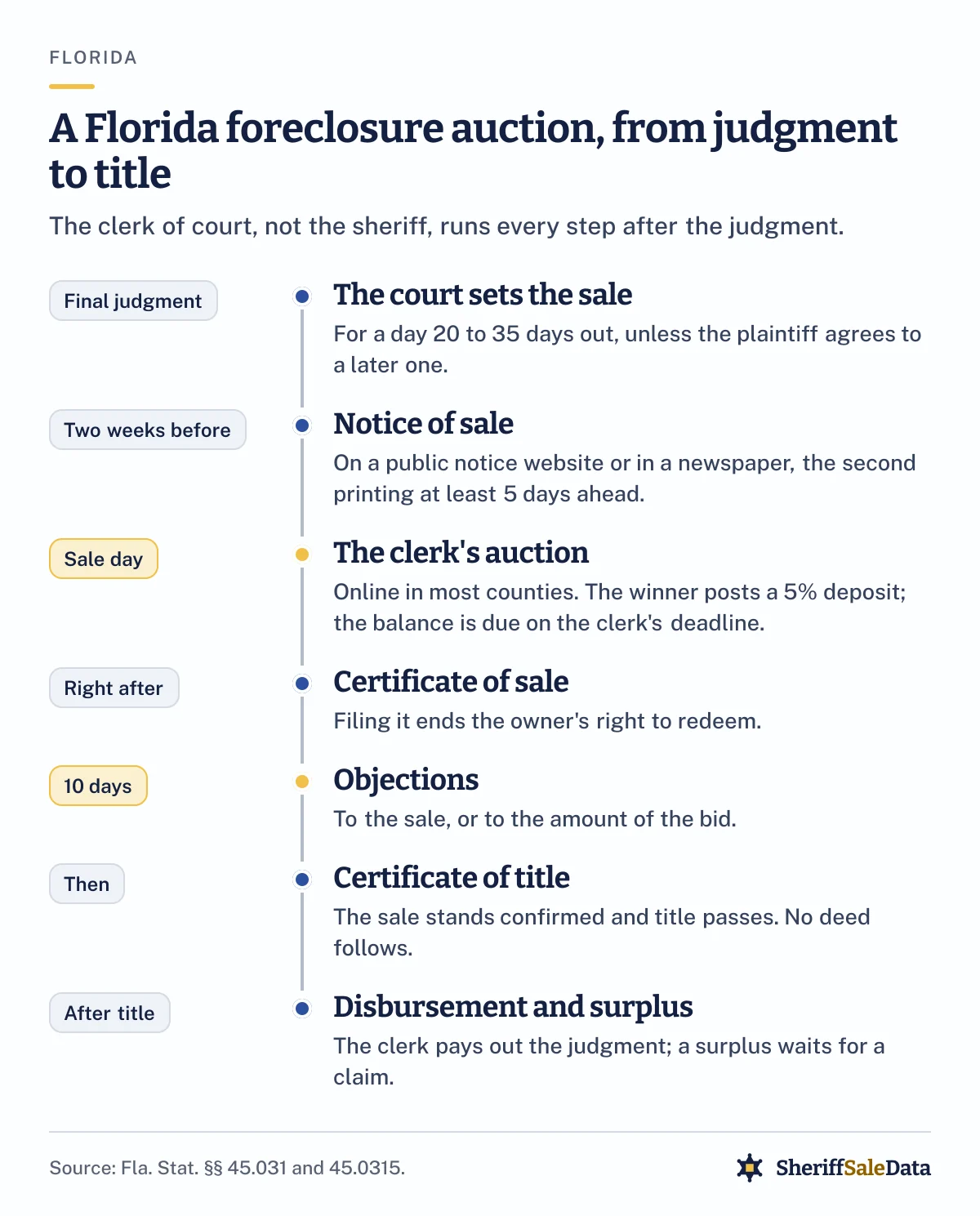
A Florida mortgage foreclosure is a lawsuit in the circuit court. When the court enters a final judgment, it directs "the clerk to sell the property at public sale on a specified day that shall be not less than 20 days or more than 35 days after the date thereof" [1]; a later date takes the plaintiff's consent. The sheriff's part comes afterwards, if at all, when a writ of possession has to be served on someone who stayed.
Most Florida clerks now run the auction online, as the statute allows. At an electronic sale "electronic proxy bidding shall be allowed and the clerk may require bidders to advance sufficient funds to pay the deposit required by subsection (3)" [2], and the clerk keeps public computer terminals for bidders without their own. Each county runs its own auction calendar with its own start times; the Florida auctions in our records start between 9 and 11 a.m. Eastern.
The notice and the auction calendar
Notice of sale "shall be published on a publicly accessible website as provided in s. 50.0311 for at least 2 consecutive weeks before the sale or once a week for 2 consecutive weeks in a newspaper of general circulation" [3], with the second newspaper printing at least five days before the sale. The notice gives the property, the time and place and the case. Each county's auction calendar lists the cases set for each day, with the final judgment amount, and the case number leads to the court file.
Because the sale comes 20 to 35 days after the judgment, Florida's lists turn over fast: a property appears a few weeks before it is sold and leaves soon after. A sale that is cancelled, often on the plaintiff's motion, can be reset to a new date; our records keep the earlier date with the new one.
Bidding against the plaintiff
The plaintiff bids the debt it is owed without paying cash, so an outside bidder has to beat the plaintiff's credit bid. Of recent Florida auctions in our records, about one in three went to an outside bidder.
At an electronic sale the clerk "shall accept an advance credit proxy bid from the plaintiff of any amount up to the maximum allowable credit bid of the plaintiff" [4]. The plaintiff enters its number before the auction, and the system bids for it up to that amount. When no one else bids, the plaintiff wins at its opening figure: of the 781 recent auctions in our records that went back to a plaintiff, 217 closed at $100 or less.
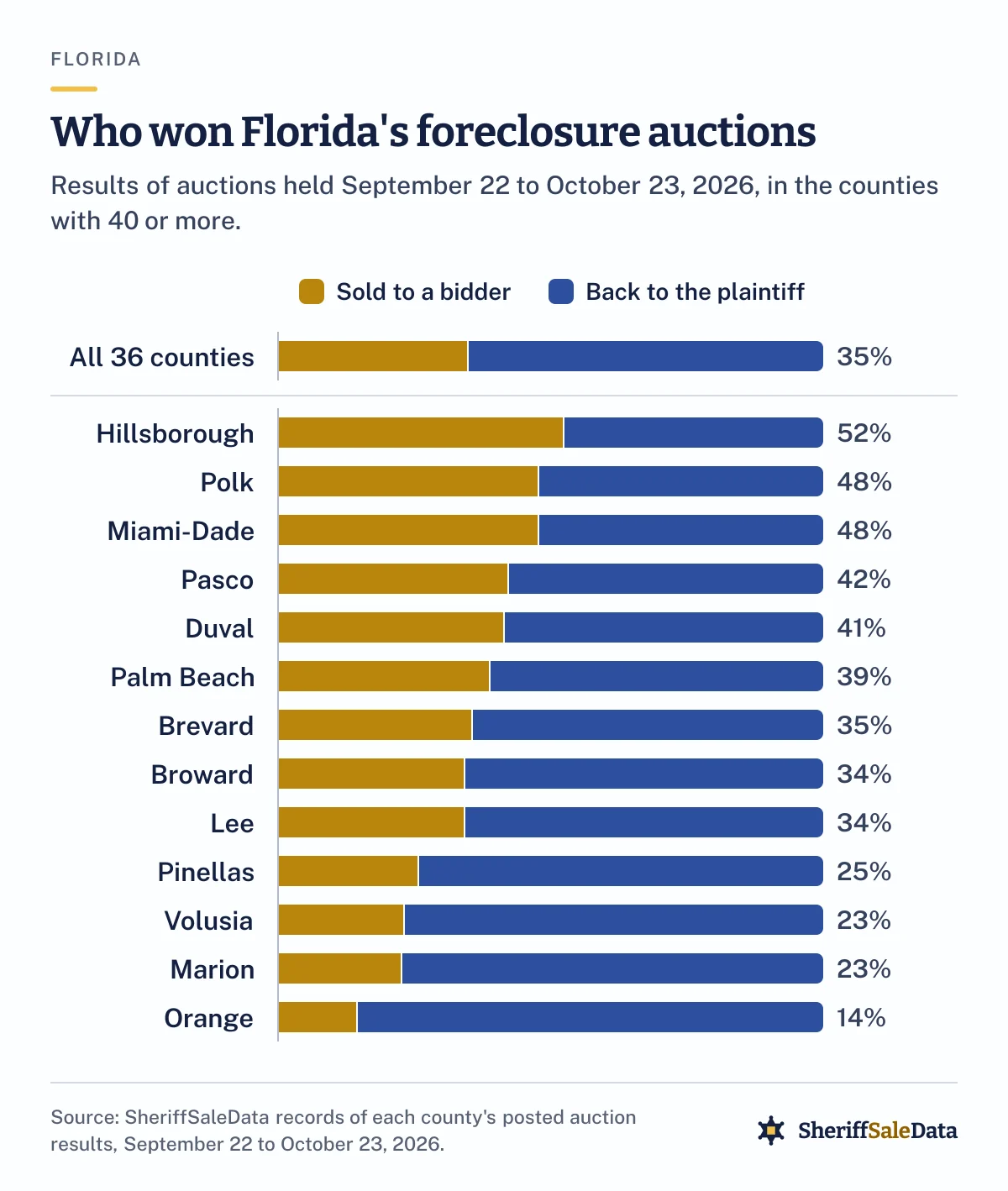
Between September 22 and October 23, 2026, 414 of the 1,195 Florida auctions in our records with a recorded result sold to an outside bidder, and 781 went back to the plaintiff. The share varies widely by county: about half in Hillsborough, Miami-Dade and Polk, one in seven in Orange. Outside buyers paid a median of $157,600 against a median judgment of $197,265; on the median sale the price was 96 percent of the judgment, and 198 of the 414 bid more than the judgment.
So the discount at a Florida auction is measured against the property's value, not against the debt. A bidder wins by knowing the value, the liens that survive and the costs better than the plaintiff's number does.
The deposit and the balance
The winning bidder posts 5 percent of the final bid with the clerk at the sale and pays the balance by the deadline the clerk and the judgment set. Miss it and the clerk sells the property again, paying the costs out of the deposit.
"At the time of the sale, the successful high bidder shall post with the clerk a deposit equal to 5 percent of the final bid" [5]. Online, that means funding your auction account before you bid: the clerk can require it in advance, and some clerks need several business days to clear an electronic transfer.
The deadline for the balance is the clerk's. Some counties want it by 4 p.m. on the day of the sale; others allow until mid-morning or early afternoon of the next business day. Read the county's auction rules and the final judgment before bidding. "If final payment is not made within the prescribed period, the clerk shall readvertise the sale as provided in this section and pay all costs of the sale from the deposit" [6], and what is left of the deposit goes toward the judgment, not back to the bidder.
On top of the bid come the clerk's fees and documentary stamp tax on the certificate of title, for which "the amount of the tax shall be computed based solely on the amount of the highest and best bid received for the property at the foreclosure sale" [7]. The statewide rate is 70 cents for each $100 [8]: $1,400 on a $200,000 bid.
What survives the sale
A Florida foreclosure sale clears the mortgage foreclosed and the junior interests named in the case. Property taxes, any senior lien, and a condominium or HOA's unpaid assessments stay with the property and the buyer.
- Property taxes. "All taxes imposed pursuant to the State Constitution and laws of this state shall be a first lien, superior to all other liens" [9]. Unpaid taxes, and any tax certificate sold on them, stay with the property; ask the county tax collector what is owed.
- A senior mortgage, when the sale is on a second mortgage or an association's lien.
- Condominium and HOA assessments. A condominium buyer at a foreclosure sale is "jointly and severally liable with the previous owner for all unpaid assessments that came due up to the time of transfer of title" [10], and the homeowners' association statute says the same of a parcel [11]. The cap those statutes give a foreclosing first mortgagee is written for the mortgagee, not for an outside bidder: find the association's balance before you bid and price in all of it.
- Federal liens. If the United States holds a recorded lien and was not made a party, the sale is made "subject to and without disturbing the lien of the United States" [12]. If it was a party and its lien was junior, it keeps a right to redeem after the sale [13].
- Code enforcement liens and utility charges, depending on the city and on whether the lienholder was named in the case. Check the local code enforcement records.
Sales on an association's own lien run the other way round. When a condominium or homeowners' association forecloses for unpaid assessments, a first mortgage recorded earlier usually stays, because "as to first mortgages of record, the lien is effective from and after recording of a claim of lien in the public records of the county in which the parcel is located" [14]. A bid at an association's sale buys the property with the mortgage on it. The auction calendar does not always say which kind of foreclosure a case is; the complaint does.
Certificate of sale, objections and title
Florida's buyer gets no deed. The clerk files a certificate of sale and, if no one objects within 10 days, a certificate of title that confirms the sale and passes title.
After the auction the clerk files a certificate of sale, and the filing ends the owner's last chance: the owner or a junior lienholder can cure the debt and stop the sale "At any time before the later of the filing of a certificate of sale by the clerk of the court or the time specified in the judgment" [15]. Then ten days run. "If no objections to the sale are filed within 10 days after filing the certificate of sale, the clerk shall file a certificate of title" [16], and "Any party may serve an objection to the amount of the bid within 10 days after the clerk files the certificate of sale" [17]. An objection goes to the judge, and the certificate of title waits for the ruling.
"When the certificate of title is filed the sale shall stand confirmed, and title to the property shall pass to the purchaser named in the certificate without the necessity of any further proceedings or instruments" [18]. The clerk records it. A title insurer may still review the case file before insuring the new title, so leave time for it.
Surplus
When the winning bid is more than the judgment, interest, costs and fees, the clerk holds the difference. Junior lienholders who file in time are paid from it, and "There is established a rebuttable legal presumption that the owner of record on the date of the filing of a lis pendens is the person entitled to surplus funds after payment of subordinate lienholders who have timely filed a claim" [19]. The buyer has no share in it, however far the bid ran past the judgment.
Possession
The certificate of title makes you the owner; it does not empty the house. If the former owner stays, the buyer asks the court in the foreclosure case for a writ of possession, which the sheriff serves. A bona fide tenant is entitled to "a notice to vacate to any bona fide tenant at least 90 days before the effective date of such notice" [20], and to the rest of a bona fide lease in most cases.
Before you bid in Florida
- Pull the court file: the final judgment (the amount, the sale date and any special terms) and the complaint (which lien is foreclosed, and who was named).
- Ask the tax collector for unpaid taxes and outstanding tax certificates.
- For a condominium or HOA property, find the association's arrears; at an association's own sale, find the first mortgage.
- Search the official records for liens recorded ahead of the one being foreclosed.
- Drive by. There is no inspection, and the owner may still live there.
- Fund the 5 percent deposit days ahead, and have the balance ready for the county's deadline.
- Put the documentary stamp tax and the clerk's fees into your maximum; how to buy at a sheriff sale sets out the rest.
- Check the auction calendar on the morning of the sale: cancellations come late.
The Florida foreclosure auctions by county page has every upcoming sale we read, the sheriff sale calendar has each county's auction days, and why sheriff sales get postponed covers the federal 37-day rule that cancels many Florida sales.
Sources
- [1]Fla. Stat. § 45.031(1)(a) — Florida Legislature“the court shall direct the clerk to sell the property at public sale on a specified day that shall be not less than 20 days or more than 35 days after the date thereof”
- [2]Fla. Stat. § 45.031(10) — Florida Legislature“electronic proxy bidding shall be allowed and the clerk may require bidders to advance sufficient funds to pay the deposit required by subsection (3)”
- [3]Fla. Stat. § 45.031(2) — Florida Legislature“Notice of sale shall be published on a publicly accessible website as provided in s. 50.0311 for at least 2 consecutive weeks before the sale or once a week for 2 consecutive weeks in a newspaper of general circulation”
- [4]Fla. Stat. § 45.031(10) — Florida Legislature“shall accept an advance credit proxy bid from the plaintiff of any amount up to the maximum allowable credit bid of the plaintiff”
- [5]Fla. Stat. § 45.031(3) — Florida Legislature“At the time of the sale, the successful high bidder shall post with the clerk a deposit equal to 5 percent of the final bid.”
- [6]Fla. Stat. § 45.031(3) — Florida Legislature“If final payment is not made within the prescribed period, the clerk shall readvertise the sale as provided in this section and pay all costs of the sale from the deposit.”
- [7]Fla. Stat. § 201.02(9) — Florida Legislature“However, the amount of the tax shall be computed based solely on the amount of the highest and best bid received for the property at the foreclosure sale.”
- [8]Fla. Stat. § 201.02(1)(a) — Florida Legislature“on each $100 of the consideration therefor the tax shall be 70 cents”
- [9]Fla. Stat. § 197.122(1) — Florida Legislature“All taxes imposed pursuant to the State Constitution and laws of this state shall be a first lien, superior to all other liens”
- [10]Fla. Stat. § 718.116(1)(a) — Florida Legislature“a unit owner is jointly and severally liable with the previous owner for all unpaid assessments that came due up to the time of transfer of title”
- [11]Fla. Stat. § 720.3085(2)(b) — Florida Legislature“A parcel owner is jointly and severally liable with the previous parcel owner for all unpaid assessments that came due up to the time of transfer of title.”
- [12]26 U.S.C. § 7425(a)(1) — United States Congress“shall be made subject to and without disturbing the lien of the United States, if notice of such lien has been filed in the place provided by law for such filing at the time such action or suit is commenced”
- [13]28 U.S.C. § 2410(c) — United States Congress“Where a sale of real estate is made to satisfy a lien prior to that of the United States, the United States shall have one year from the date of sale within which to redeem, except that with respect to a lien arising under the internal revenue laws the period shall be 120 days or the period allowable for redemption under State law, whichever is longer”
- [14]Fla. Stat. § 720.3085(1) — Florida Legislature“However, as to first mortgages of record, the lien is effective from and after recording of a claim of lien in the public records of the county in which the parcel is located.”
- [15]Fla. Stat. § 45.0315 — Florida Legislature“At any time before the later of the filing of a certificate of sale by the clerk of the court or the time specified in the judgment, order, or decree of foreclosure, the mortgagor or the holder of any subordinate interest may cure the mortgagor's indebtedness and prevent a foreclosure sale”
- [16]Fla. Stat. § 45.031(5) — Florida Legislature“If no objections to the sale are filed within 10 days after filing the certificate of sale, the clerk shall file a certificate of title”
- [17]Fla. Stat. § 45.031(8) — Florida Legislature“Any party may serve an objection to the amount of the bid within 10 days after the clerk files the certificate of sale.”
- [18]Fla. Stat. § 45.031(6) — Florida Legislature“When the certificate of title is filed the sale shall stand confirmed, and title to the property shall pass to the purchaser named in the certificate without the necessity of any further proceedings or instruments.”
- [19]Fla. Stat. § 45.032(2) — Florida Legislature“There is established a rebuttable legal presumption that the owner of record on the date of the filing of a lis pendens is the person entitled to surplus funds after payment of subordinate lienholders who have timely filed a claim.”
- [20]Protecting Tenants at Foreclosure Act, Pub. L. 111-22 § 702 (12 U.S.C. § 5220 note) — United States Congress“the provision, by such successor in interest of a notice to vacate to any bona fide tenant at least 90 days before the effective date of such notice”
Questions
How do foreclosure auctions work in Florida?
After a final judgment of foreclosure, the court directs the clerk to sell the property at a public auction on a day 20 to 35 days later. The sale is advertised for two weeks, most clerks run it online, and the highest bidder posts a 5 percent deposit and pays the balance by the clerk's deadline. The clerk then files a certificate of sale and, if no one objects within 10 days, a certificate of title that passes title to the buyer.
How much is the deposit at a Florida foreclosure auction?
Five percent of the final bid, posted with the clerk. At an online sale the clerk can require the deposit to be in your bidding account before you bid, and some clerks need several business days to clear an electronic transfer, so fund it early. The deposit is applied to the price when you pay the balance.
When is the balance due after a Florida foreclosure auction?
When the clerk says. The statute leaves the deadline to each clerk and the final judgment: some counties want the balance by 4 p.m. on the day of the sale, others by mid-morning or early afternoon the next business day. If it is not paid in time, the clerk advertises the sale again and pays the costs from your deposit, and the rest of the deposit goes toward the judgment.
Do you get a deed at a Florida foreclosure auction?
No. The buyer gets a certificate of title from the clerk. When it is filed, the sale stands confirmed and title passes without any further proceeding or instrument. Documentary stamp tax is due on the certificate, computed on the winning bid.
Can the owner get the house back after a Florida foreclosure auction?
Not once the clerk files the certificate of sale, unless the judgment set a later time. Until then the owner or a junior lienholder can cure the debt and stop the sale. One exception outlasts it: if the United States held a junior lien in the case, it can redeem for a year after the sale, or 120 days for a federal tax lien.
What is the 37-day foreclosure rule?
A federal mortgage servicing rule, not a Florida one. If a borrower submits a complete loss mitigation application after the foreclosure has started but more than 37 days before the sale, the servicer may not move for judgment or conduct the sale until the application has been evaluated. It is one reason foreclosure sales are cancelled and reset.
What happens at an HOA foreclosure auction in Florida?
An association that forecloses its own lien for unpaid assessments sells only what that lien reaches. Against a first mortgage recorded earlier, the association's lien counts only from the recording of its claim of lien, so a buyer at an association's sale usually takes the property with the first mortgage still on it.
Who gets the surplus from a Florida foreclosure auction?
Money left after the judgment, interest and costs are paid is held by the clerk. Junior lienholders who file timely claims are paid from it first, and the law presumes the rest belongs to the owner of record on the date the lis pendens was filed. The buyer has no claim to it.
Where next
- Sheriff sale calendarEvery county's upcoming sale days, with property counts and start times.
- Sheriff sale guidesHow a sheriff sale works, how to bid, and the rules for Florida, New Jersey, Ohio, Pennsylvania and Philadelphia.
- Foreclosing lendersThe banks, servicers and trusts bringing sheriff sales, with every county they foreclose in.
- Sheriff sale glossaryUpset price, writ of execution, adjournment, credit bid — every term a listing uses.
General information about Florida procedure, not legal advice. Each clerk of court sets its own deposit, payment deadline and auction rules, and statutes change; confirm with the clerk before bidding.