Guide 09
Philadelphia sheriff sales, from the list to the deed
9 min read · updated October 25, 2026

Philadelphia holds more sheriff sales than any other county in our records. Our records hold 1,487 upcoming Philadelphia County sheriff sales (845 mortgage foreclosures and 638 tax sales). The next is on October 27, 2026, and 882 of them have already been postponed at least once. The Sheriff sells online, in volume and on strict terms: a deposit before you bid, money due the next day, the balance in 15 days and no extensions. This guide takes a Philadelphia sale in the order a bidder meets it. The statewide rules underneath are in the Pennsylvania guide.
Two kinds of sale
The Sheriff sells mortgage foreclosures on the first Tuesday of each month and the City's tax foreclosures on other days. Both are online auctions under the same Pennsylvania rules, with different deposits, bid steps and opening bids.
Mortgage foreclosure sales. A lender, servicer or trust wins a foreclosure judgment in the Court of Common Pleas, and a writ of execution sends the property to the Sheriff. These sales are held once a month, on the first Tuesday, often several hundred properties at a time. An owner-occupied home reaches the list only after the court's Residential Mortgage Foreclosure Diversion Program: when the plaintiff files, "a conciliation conference is scheduled an Order is issued preventing Plaintiff from entering judgment until after the conciliation conferences have been concluded" [1].
Tax sales. The City collects delinquent real estate taxes under the Municipal Claims and Tax Liens Act, through a court judgment and a sheriff sale rather than a county tax claim bureau. These auctions run on several other days each month. The opening bid on a tax-delinquent property is $1,600, and the Philadelphia Land Bank can enter priority bids on properties it has picked from the list; on those, no other bid is accepted. What happens after a tax sale differs too: see the nine-month redemption.
Reading the sale list
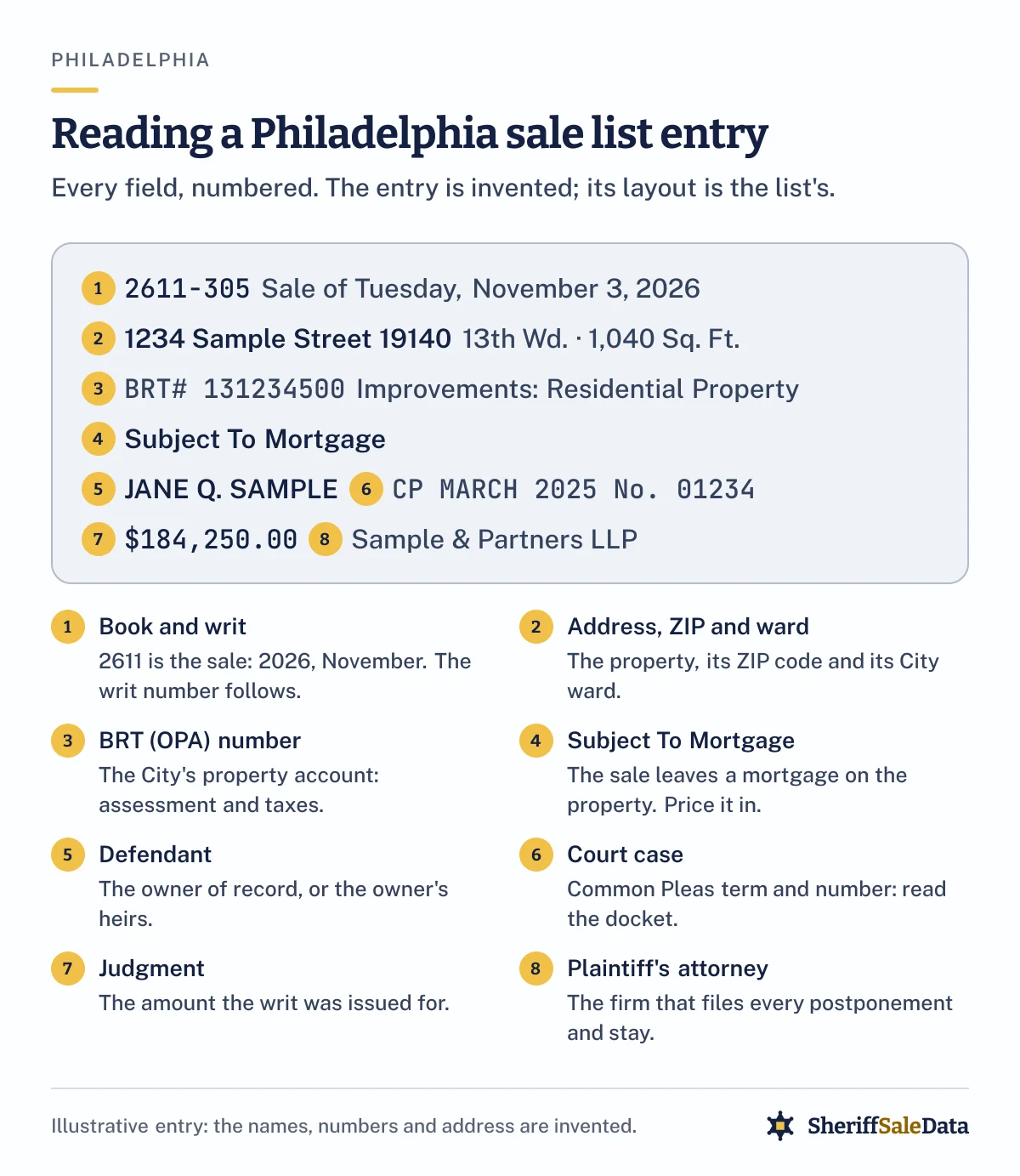
Every entry on the Sheriff's list follows the same layout:
- The book and writ number. The first four digits are the sale's year and month: 2611 is November 2026, 2610 is October. The writ number after the hyphen is the property's place in that sale.
- The address, ZIP code and ward, with the lot size and the kind of improvement.
- The BRT number, the property's account with the City's Office of Property Assessment, also called the OPA number. It opens the City's property record: the assessment, the real estate tax balance and any code violations.
- "Subject To Mortgage", on some entries. The sale will not clear a mortgage on the property, and the buyer takes the property with it.
- The defendant: the owner of record or, often, the heirs of an owner who has died.
- The court term and number, such as "CP FEB 2025 No. 00540": the foreclosure case in the Court of Common Pleas, which you can read on the court's civil docket.
- The judgment amount and the plaintiff's attorney. The attorney's firm files the postponements and stays.
Each sale is advertised "once a week for three successive weeks", the first publication "not less than twenty-one days before the date of sale" [2], so the list for a date is complete about three weeks out. It changes after that: properties are postponed, stayed and pulled until the auction closes.
Before the auction: register and deposit
To bid you register on the Sheriff's online auction site and post one deposit before the auction starts: $10,000 for a mortgage foreclosure sale or $1,500 for a tax sale, plus a $35 processing fee.
The deposit is one amount per auction day, and it lets you bid on every property in that day's auction. At a mortgage sale it counts toward the 10 percent down payment on whatever you win: if your purchases call for more than $10,000, the difference is due by 5 p.m. the next business day, and if less, the excess goes toward your balance. A bidder who wins nothing gets the deposit back.
A few rules decide who can buy. You must be 18 or older. The Sheriff will not deed a property to an unregistered fictitious name. If the deed is to go to anyone other than the registered bidder, a notarized assignment of bid has to be filed with the Sheriff's Office. And the winner of a tax sale must obtain a tax compliance certificate from the City's Department of Revenue, showing the buyer is not delinquent; if the bid is assigned, the assignee needs one too.
Do the research before the deposit, not after. The property is sold as is, and the conditions of sale make the bidder responsible for every lien, encumbrance and mortgage the Sheriff's schedule of distribution may not pay off.
How the bidding works
Bidding opens at 10 a.m. You can bid by hand or enter a maximum and let the auction site bid for you up to it. Bids rise in steps of at least $1,000 at a mortgage sale and $100 at a tax sale. The Sheriff's own guidance is that auctions close at about 1 p.m., and that a bid in the last five minutes sends an auction into overtime until five minutes pass without one.
The reserve. At a mortgage foreclosure sale the plaintiff's attorney submits an upset price, the least the plaintiff will accept, at least an hour before the auction. The Sheriff adds the costs of the sale to it, and the total is the reserve. Bidders never see the reserve; they see only when the bidding has met it. If it does not, the property is not sold to a bidder, and the plaintiff takes it on its credit bid: the Sheriff accepts the plaintiff's receipt "up to the amount of the proceeds to which the purchaser is entitled" [3] instead of cash.
The second bidder. When a property sells to an outside bidder, the bidder directly outbid can register as the second bidder at the same price, with 10 percent down by 5 p.m. the next business day. If the winner defaults, the second bidder has five calendar days to complete the purchase; if the winner pays, the second bidder's deposit is returned.
After you win: 10 percent, then 15 days
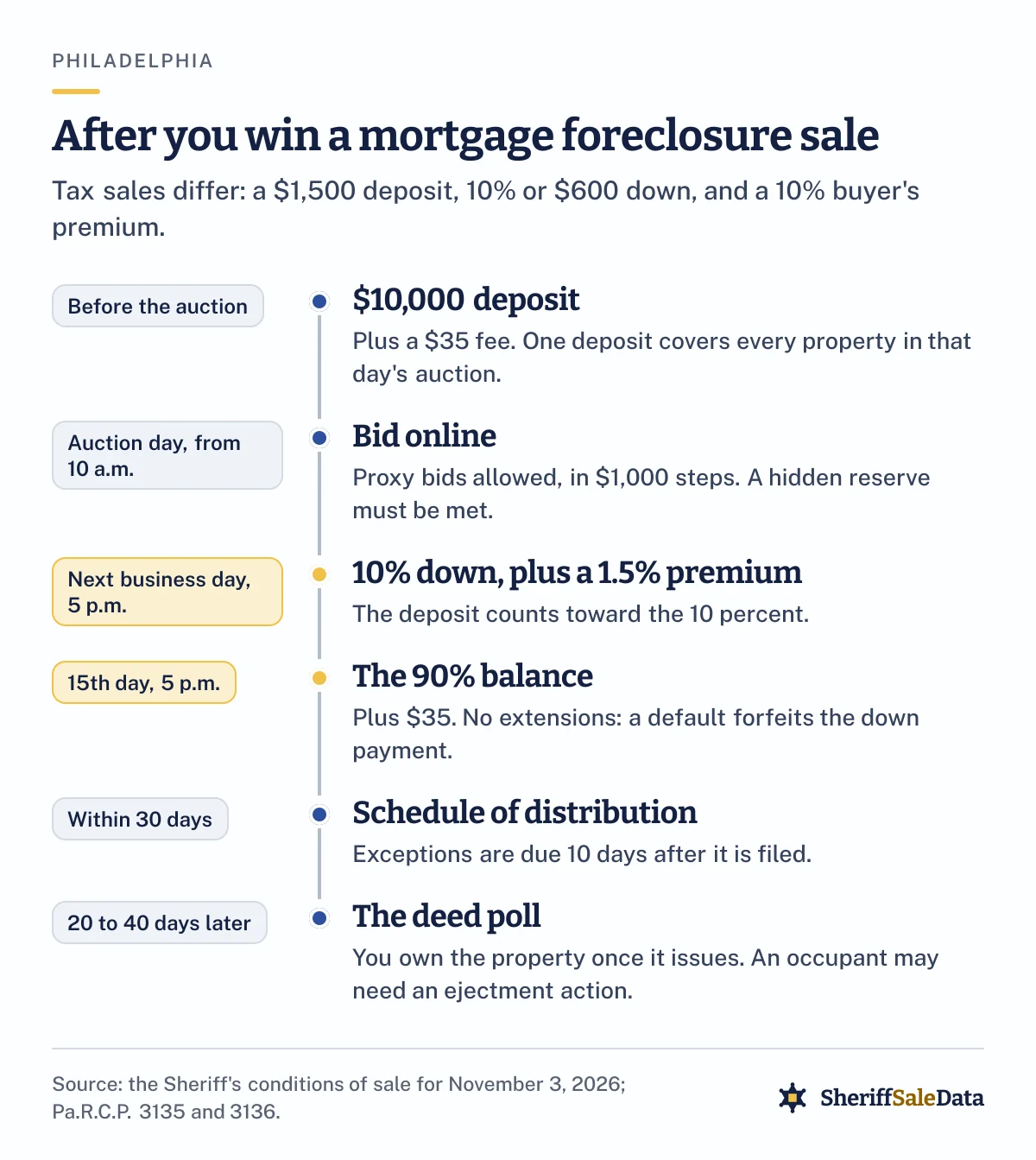
A Philadelphia winner pays 10 percent of the price plus a buyer's premium by 5 p.m. the next business day, and the other 90 percent plus $35 by 5 p.m. on the 15th calendar day after the auction. There are no extensions.
The buyer's premium is 1.5 percent of the price at a mortgage foreclosure sale. At a tax sale it is 10 percent, and the down payment is 10 percent of the price or $600, whichever is greater. If the 15th day falls on a weekend or a holiday, the balance is due by 5 p.m. the next business day. The realty transfer taxes are already calculated into the bid amount; the buyer also pays any post-sale costs the law puts on the Sheriff.
Miss a deadline and the sale is in default: the down payment is forfeited, the property can pass to the second bidder, and the Sheriff can bar the bidder from later sales. Pennsylvania's statewide rules leave deposits, deadlines and forfeiture to "local practice" [4], so these terms are Philadelphia's own. They are printed in the conditions of sale with every notice; read the current set before each auction.
Postponements: most sales move
A Philadelphia sale date is a plan, not a promise. The plaintiff can postpone or stay a mortgage sale until 3 p.m. the day before the auction, and its attorney can still pull a property during the auction itself. A sale moved to a date within 130 days needs no new advertising if the new date is announced at the sale [5], so a property can roll forward from month to month on the same notice. A bankruptcy filing stays a sale automatically, because the stay covers "any act to create, perfect, or enforce any lien against property of the estate" [6].
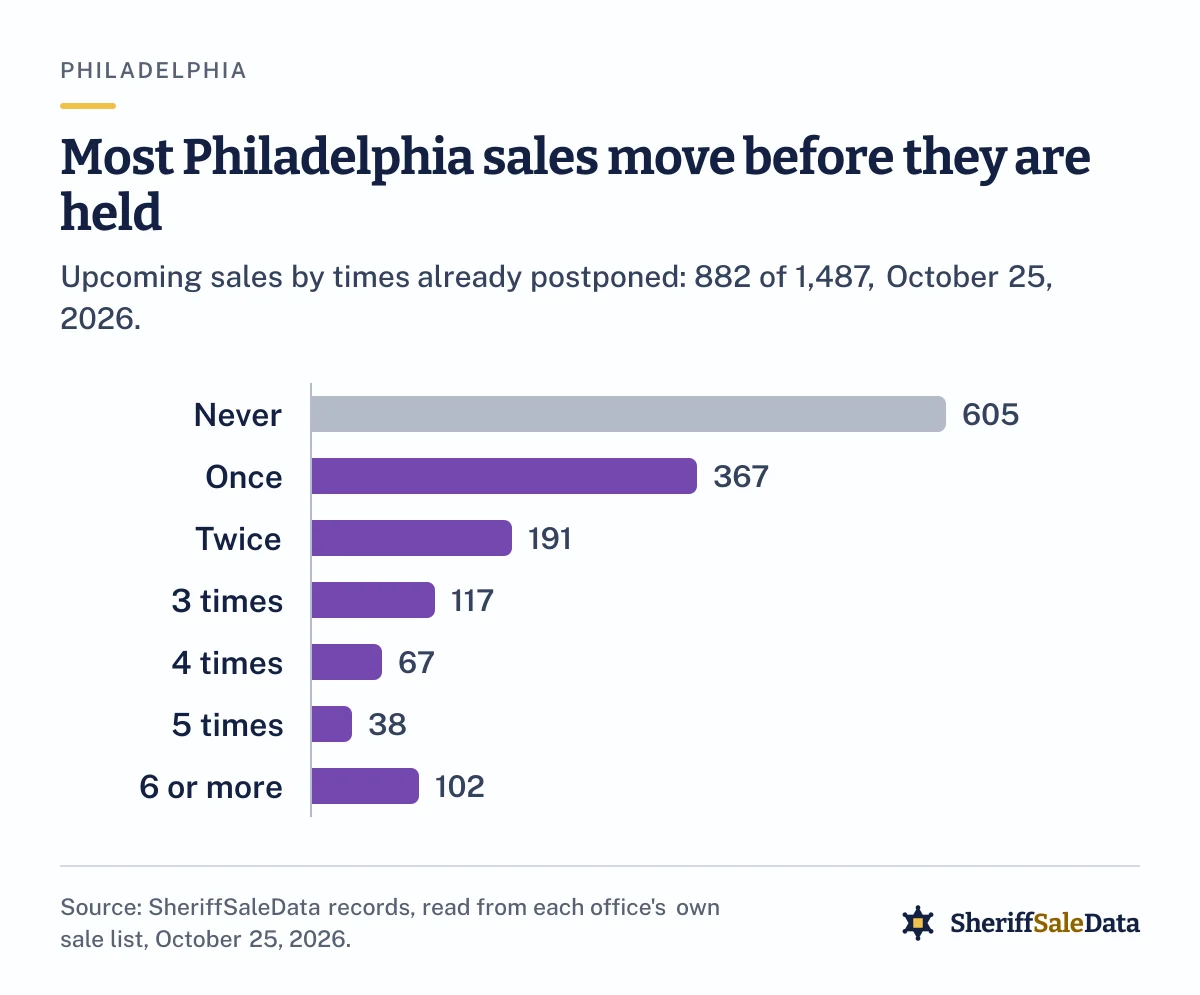
On October 25, 2026, 882 of the 1,487 upcoming Philadelphia sales in our records had been postponed at least once, and 102 had moved six times or more. Check a property's history before paying for title work, and check it again on the morning of the sale. Why sheriff sales get postponed explains how to read one.
From the sale to the deed
No court confirms a Philadelphia sheriff sale. The Sheriff files a schedule of distribution within 30 days, exceptions are due 10 days after it is filed, and the Sheriff's deed poll follows 20 to 40 days after the schedule.
The Sheriff prepares the schedule of how the proceeds will be paid out no later than 30 days after the sale [7] and files it with the Prothonotary. Distribution follows the schedule "unless written exceptions are filed with the sheriff not later than ten (10) days after the filing of the proposed schedule" [8]. Then the Sheriff executes and acknowledges the deed "at the expiration of twenty days but no later than 40 days after" the schedule is filed [9], and "Confirmation of the sale by the court shall not be required" [10]. Money left after the schedule's payouts goes to the former owner.
You own the property when the deed poll is issued, not when the auction closes. Once it is recorded, the City's Department of Records holds the deed.
Tax sales and the nine-month redemption
Buyers at a tax sale take one risk mortgage buyers do not. Property sold at a sheriff sale on a tax or municipal claim in Philadelphia can be redeemed "at any time within nine months from the date of the acknowledgment of the sheriff's deed" [11]. The exception is vacant property: "there shall be no redemption of vacant property by any person after the date of the acknowledgment of the sheriff's deed therefor" [12].
So the buyer of an occupied property at a tax sale holds it for nine months knowing the owner can take it back. Budget for the wait before spending on major work. The Land Bank's priority bids also take some properties off the table at the City's opening bid, and the 10 percent buyer's premium makes a tax sale purchase dearer than its price.
Getting possession
The Sheriff has no keys to any property. If the property is occupied, the new owner goes to court. The Sheriff's Office's published steps start with a letter giving the occupant 30 days to leave. Then come a complaint in ejectment in the Court of Common Pleas, a default judgment for possession if the occupant does not answer, and a writ of possession that the Sheriff serves. A bona fide tenant is entitled to "a notice to vacate to any bona fide tenant at least 90 days before the effective date of such notice" [13]. Many buyers negotiate a move-out instead; it is often quicker than the court.
A Philadelphia bidder's checklist
- Find the property on the sale list, and note the book and writ number, the BRT number and the court number.
- Read the case on the Court of Common Pleas civil docket: what was foreclosed, who was named, and any bankruptcy.
- Look up the BRT number in the City's property records for the assessment, taxes and code violations.
- Check whether the entry says "Subject To Mortgage", and order a title search.
- Drive by. Look from the street; do not go onto the property.
- Work out your maximum, with the 1.5 or 10 percent premium in it; how to buy at a sheriff sale sets out the deductions.
- Post the deposit before the auction and arrange the whole price: 10 percent the next business day, 90 percent in 15 days.
- Check the property's status the morning of the sale.
The Philadelphia County sale list has every upcoming sale with its postponement history, the sheriff sale calendar has the dates, and the foreclosing lenders pages show who is bringing the sales.
Sources
- [1]Residential Mortgage Foreclosure Diversion Program — Court of Common Pleas of Philadelphia County“a conciliation conference is scheduled an Order is issued preventing Plaintiff from entering judgment until after the conciliation conferences have been concluded”
- [2]Pa.R.C.P. 3129.2(d) — Supreme Court of Pennsylvania (Pennsylvania Code)“shall also be given by publication by the sheriff once a week for three successive weeks in one newspaper of general circulation in the county and in the legal publication, if any, designated by rule of court for publication of notices, the first publication to be made not less than twenty-one days before the date of sale”
- [3]Pa.R.C.P. 3133 — Supreme Court of Pennsylvania (Pennsylvania Code)“the sheriff upon proof of that fact shall accept on account of the purchase price the receipt of the purchaser up to the amount of the proceeds to which the purchaser is entitled”
- [4]Pa.R.C.P. 3128, Official Note (applied to real property by the note to Rule 3129.2) — Supreme Court of Pennsylvania (Pennsylvania Code)“The time of sale, terms and conditions as to amount of deposit, time for payment of balance, forfeiture of deposit, resales or forfeiture and similar matters are not regulated by these rules and will be governed by local practice in order to permit greater adaptability to the wide variety of local conditions and customs.”
- [5]Pa.R.C.P. 3129.3(b)(1) — Supreme Court of Pennsylvania (Pennsylvania Code)“If the sale is stayed, continued, postponed or adjourned to a date certain within one hundred thirty days of the scheduled sale, notice of which sale was given as provided by Rule 3129.2, and public announcement thereof, including the new date, is made to the bidders assembled at the time and place fixed for the sale, no new notice as provided by Rule 3129.2 shall be required”
- [6]11 U.S.C. § 362(a)(4) — United States Congress“any act to create, perfect, or enforce any lien against property of the estate”
- [7]Pa.R.C.P. 3136(a) — Supreme Court of Pennsylvania (Pennsylvania Code)“Not later than thirty days after the sale of real property and not later than five days after the sale of personal property, the sheriff shall prepare a schedule of proposed distribution of the proceeds of sale”
- [8]Pa.R.C.P. 3136(d) — Supreme Court of Pennsylvania (Pennsylvania Code)“The sheriff shall distribute the proceeds of sale in accordance with the proposed schedule of distribution, unless written exceptions are filed with the sheriff not later than ten (10) days after the filing of the proposed schedule.”
- [9]Pa.R.C.P. 3135(a) — Supreme Court of Pennsylvania (Pennsylvania Code)“at the expiration of twenty days but no later than 40 days after either the filing of the schedule of distribution or the execution sale if no schedule of distribution need be filed, shall execute and acknowledge before the prothonotary a deed to the property sold”
- [10]Pa.R.C.P. 3135(a) — Supreme Court of Pennsylvania (Pennsylvania Code)“Confirmation of the sale by the court shall not be required.”
- [11]53 P.S. § 7293(a) — Pennsylvania General Assembly“redeem the same if the property is not located in a city of the second class or a county of the second class or a municipality therein at any time within nine months from the date of the acknowledgment of the sheriff's deed”
- [12]53 P.S. § 7293(c) — Pennsylvania General Assembly“there shall be no redemption of vacant property by any person after the date of the acknowledgment of the sheriff's deed therefor”
- [13]Protecting Tenants at Foreclosure Act, Pub. L. 111-22 § 702 (12 U.S.C. § 5220 note) — United States Congress“the provision, by such successor in interest of a notice to vacate to any bona fide tenant at least 90 days before the effective date of such notice”
Questions
When are Philadelphia sheriff sales held?
Mortgage foreclosure sales are held once a month, on the first Tuesday, and the City's tax sales on several other days each month. All of them are online auctions that open at 10 a.m. Eastern. Each sale is advertised at least three weeks ahead, with the full list of properties.
Where can I find the Philadelphia sheriff sale list?
The Sheriff's Office posts each auction's property list on its own website, and every sale is advertised in the legal newspaper the court designates at least three weeks before it. SheriffSaleData keeps every upcoming Philadelphia sale, mortgage and tax, in one list with the address and ZIP code, the sale date, the judgment, the plaintiff and the postponement history.
How much money do you need to bid at a Philadelphia sheriff sale?
A $10,000 deposit for a mortgage foreclosure auction, or $1,500 for a tax sale, plus a $35 fee, posted before the auction starts. If you win, 10 percent of the price and a buyer's premium (1.5 percent at a mortgage sale, 10 percent at a tax sale) are due by 5 p.m. the next business day, and the 90 percent balance by 5 p.m. on the 15th calendar day. There is no financing contingency, so have the whole price arranged before you bid.
What happens if no one bids at a Philadelphia sheriff sale?
At a mortgage foreclosure sale a property goes to an outside bidder only if the bidding reaches the reserve, which is the plaintiff's upset price plus the Sheriff's costs. If it does not, the plaintiff takes the property on its own bid, paying with the judgment it is owed rather than cash.
Can you look inside a house before a Philadelphia sheriff sale?
No. The Sheriff has no keys and no information on the property's condition, and warns bidders that setting foot on a property before the auction is trespassing. Bidders look from the street or the sidewalk and read the court docket and the City's property records instead.
How long does an occupant have to leave after a Philadelphia sheriff sale?
There is no set date, because the buyer has to go to court. The buyer becomes the owner when the Sheriff's deed poll is issued, weeks after the sale; an occupant who stays is removed through an ejectment action in the Court of Common Pleas and a writ of possession. A bona fide tenant is entitled under federal law to at least 90 days' notice to vacate.
How do you stop a sheriff sale in Philadelphia?
Only the plaintiff, a court order or a bankruptcy filing stops one. The plaintiff can postpone or stay a sale up to and during the auction, and a bankruptcy petition stays it automatically. Before any of that, an owner-occupied home goes through the court's Residential Mortgage Foreclosure Diversion Program, where the owner meets the lender at a conciliation conference before judgment can be entered.
Do you have to pay back taxes after buying at a Philadelphia sheriff sale?
Possibly. The realty transfer tax is already included in the bid, but the proceeds pay claims in the order of the Sheriff's schedule of distribution, and the conditions of sale leave the buyer any lien or mortgage the schedule does not satisfy. Check the City's real estate tax and water balances for the property, and whether the listing is marked Subject To Mortgage, before you bid.
Where next
- Sheriff sale calendarEvery county's upcoming sale days, with property counts and start times.
- Sheriff sale guidesHow a sheriff sale works, how to bid, and the rules for Florida, New Jersey, Ohio, Pennsylvania and Philadelphia.
- Foreclosing lendersThe banks, servicers and trusts bringing sheriff sales, with every county they foreclose in.
- Sheriff sale glossaryUpset price, writ of execution, adjournment, credit bid — every term a listing uses.
General information about Pennsylvania procedure, not legal advice. Each county sheriff sets its own deposit and terms, and the rules change; confirm with the sheriff's office before bidding.