Guide 07
Master commissioner sales, from the appraisal to the deed
12 min read · updated November 16, 2026
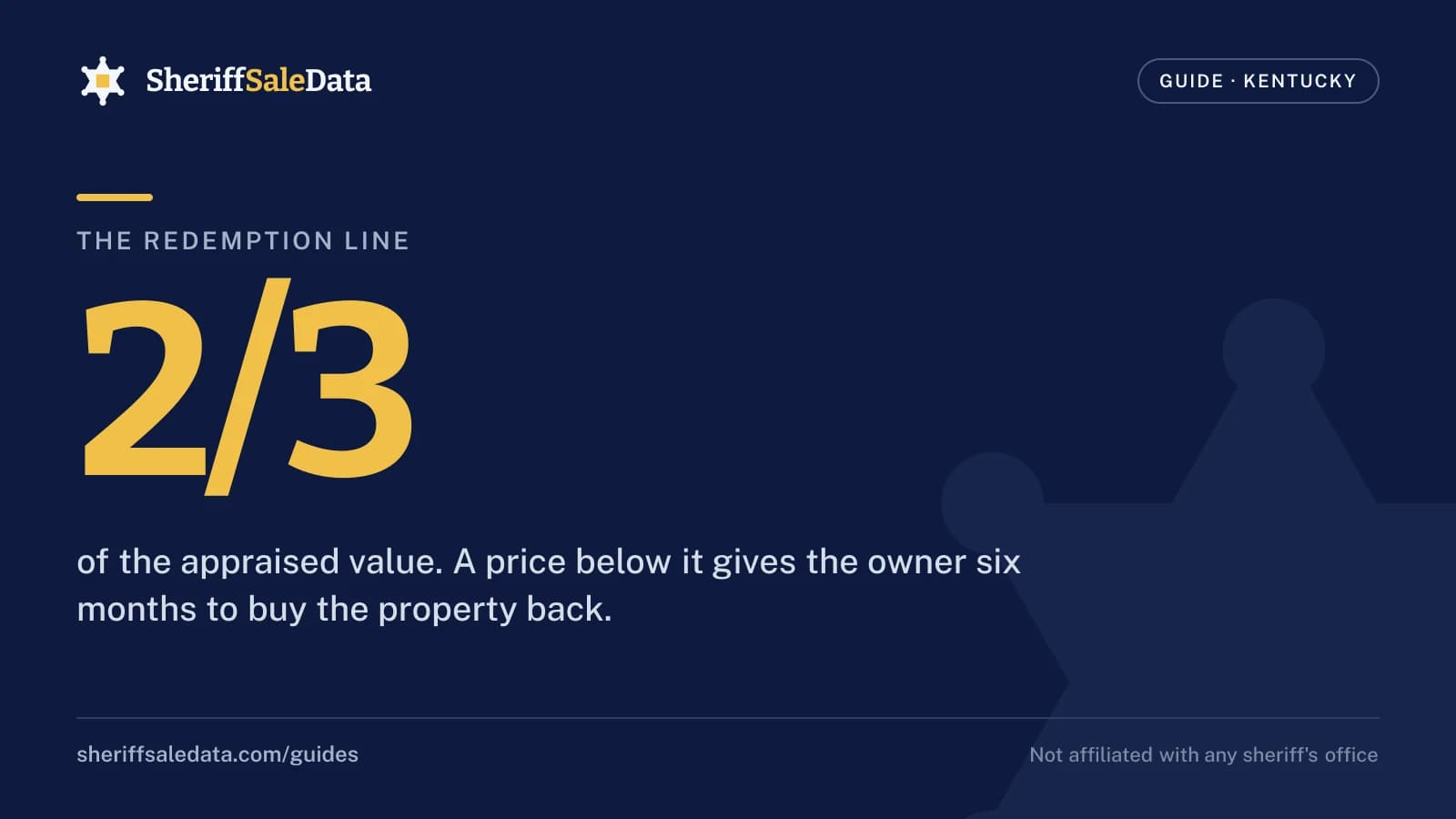
In Kentucky the sheriff does not sell foreclosed homes. The circuit court's master commissioner does, under rules that since January 1, 2026 are the same in every county: an appraisal before the sale, 10 percent down and a bond for the rest, and a right for the owner to redeem when the price falls below two-thirds of the appraisal. Our records hold 171 upcoming Kentucky master commissioner sales in 11 counties; the next is in Boone County on November 19, 2026, with 4 properties listed. This guide follows a sale from the judgment to the deed.
Who sells: the master commissioner
A master commissioner is an attorney appointed by the circuit judges to carry out the court's judicial sales, foreclosures above all. Each county can have one, and in Kentucky the sheriff sells only under an execution or attachment, not after a foreclosure judgment.
The Court of Justice describes commissioners in one line: "Appointed by the circuit judge, they help manage judicial sales—most often involving court-ordered property sales such as foreclosures" [1]. By statute "A master commissioner may be appointed for each county within a judicial circuit" [2], chosen "by a majority of the judges" where the circuit has more than one [3], and commissioners "shall be qualified as licensed attorneys in good standing with the Kentucky Bar Association" [4]. When the regular commissioner cannot act, the judge appoints "a special commissioner, who shall meet the same qualifications" [5], which is why some notices read "special master commissioner". Jefferson County's rules put the division plainly: "all judicial sales may be made by the Master Commissioner. The Sheriff shall make sales under execution or attachment" [6].
Most commissioner sales are mortgage foreclosures, but not all. A partition of co-owned land goes "to the master commissioner" when the court orders it sold [7], and a holder of a delinquent-tax certificate can sue once a year has passed from the date the taxes became delinquent [8]; a property sold on that judgment "shall be appraised pursuant to the provisions of KRS 426.520, and there shall be a right of redemption as provided in KRS 426.530" [9], the same as a foreclosure. On November 16, 2026, 42 of the 178 upcoming Kentucky sales in our records were tax foreclosures.
Since January 1, 2026 the Supreme Court's rules for commissioners govern every county, and "No local rules, practices, procedures, orders, or other policies of any circuit may conflict with or controvert these rules" [10]. Beyond them, "the terms and conditions of the judicial sale or estate settlement shall be established by the circuit court either in its order or rule" [11], so each sale's ad and terms still matter.
From judgment to sale day
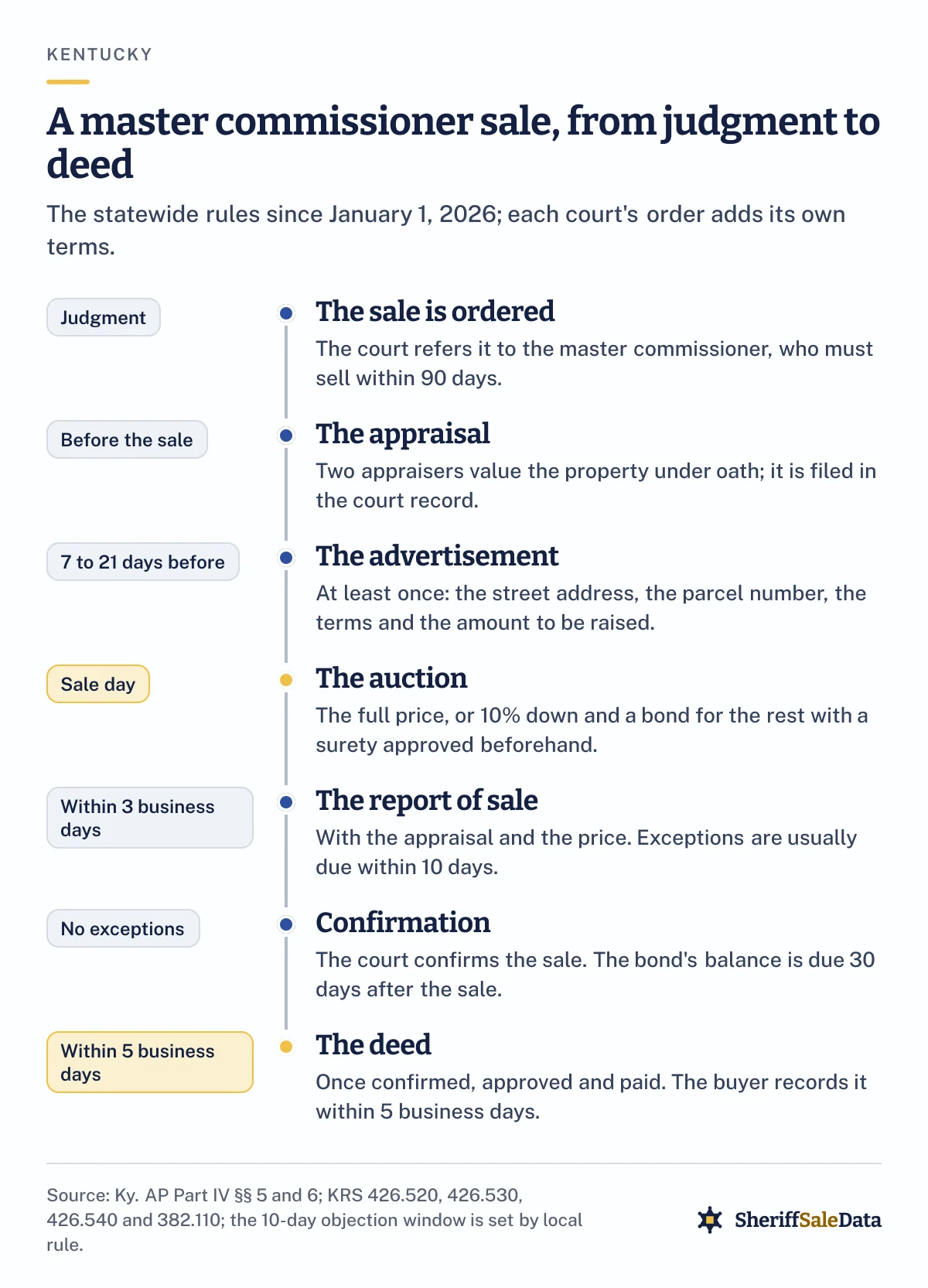
In an action to enforce a mortgage, "judgment may be rendered for the sale of the property and for the recovery of the debt against the defendant personally" [12]. The court then refers the sale to the commissioner, who "shall sell the property in a reasonable time not to exceed 90 days after the date of the order of referral" [13], extendable by up to 30 days for good cause [14]. A property the court finds vacant and abandoned must be sold "within seventy (70) days of the order" [15].
The commissioner serves notice of the date, time and place "upon every party who is not in default for failure to appear" [16], and the sale is advertised under the state's legal-notice law with "the time, place and terms of sale" and a description of the property [17]. The minimum is one ad "not less than seven days nor more than 21 days before the date of the sale" [18]; some judgments call for more. The ad describes the property by "only the street address" and the tax parcel number [19], so the legal description is in the court file. It must also state "for what sum of money it is to be made" [20]: the amount to be raised is the debt in the judgment, not the property's value, and the bidding need not reach it.
Every sale "must be public, either for cash or upon reasonable credits to be fixed by the court" [21], and unless the order says otherwise it is held "at the door of the courthouse" of the county [22]. In practice most offices hold it inside, in a courthouse room or lobby, on a day and hour of their own. If the foreclosing lender asks, the commissioner must instead "employ a licensed auctioneer to handle the sale" [23], and that sale "shall be conducted on the site of the real property to be sold" unless the auctioneer picks another place in the county [24]. Since July 15, 2026 the auctioneer's fee can reach 10 percent of the price, "which may be an auction premium or commission charged to the sale of the property" [25]. The statute does not say whether a premium is added to the bid or taken from the proceeds; read the terms of any sale held on site.
The appraisal and the two-thirds rule
Before a commissioner sale, two appraisers value the property under oath and the appraisal is filed in the case. If the price is less than two-thirds of it, the owner can redeem within six months by repaying the price, 10 percent a year and the buyer's reasonable costs.
The commissioner "shall have it appraised, under oath, by two (2) disinterested, intelligent housekeepers of the county" [26], and the Supreme Court's rule now requires two people "actively engaged in or have had at least one year of experience in the field of real estate" [27]. "Prior to the sale, the appraisal shall be filed among the papers of the cause" [28], so a bidder can read it, and several offices post it online a week or two ahead. It is no inspection report: offices have no keys and cannot let bidders in, and an appraisal can be made from the street.
The appraisal matters because of KRS 426.530: "If real property sold in pursuance of a judgment or order of a court, other than an execution, does not bring two-thirds (2/3) of its appraised value, the defendant and his or her representatives may redeem it within six (6) months from the day of sale, by paying the original purchase money and ten percent (10%) per annum interest thereon" [29], plus "any reasonable costs incurred by the purchaser after the sale for maintenance or repair of the property, including but not limited to utility expenses, insurance, association fees, taxes" [30]. The defendant pays the circuit clerk, and "the master commissioner shall convey the real property to the defendant" [31]; if that happens, the confirmation "shall thereafter be null and void" [32]. The period was a year until 2014 [33], and some offices' pages still say so.
While the right is open, the buyer is not locked out: "the purchaser shall receive an immediate writ of possession and a deed containing a lien in favor of the defendant, reflecting the defendant's right to redeem during the statutory period" [34]. But a buyer below the line can lose the property six months later at a 10 percent return, which few buyers planning to renovate will accept. No statute lets the buyer waive the right or buy it out; the sure way to avoid it is to bid at least two-thirds. On a $150,000 appraisal that is $100,000. A $90,000 bid leaves the owner six months to repay about $94,500, plus the buyer's reasonable costs.
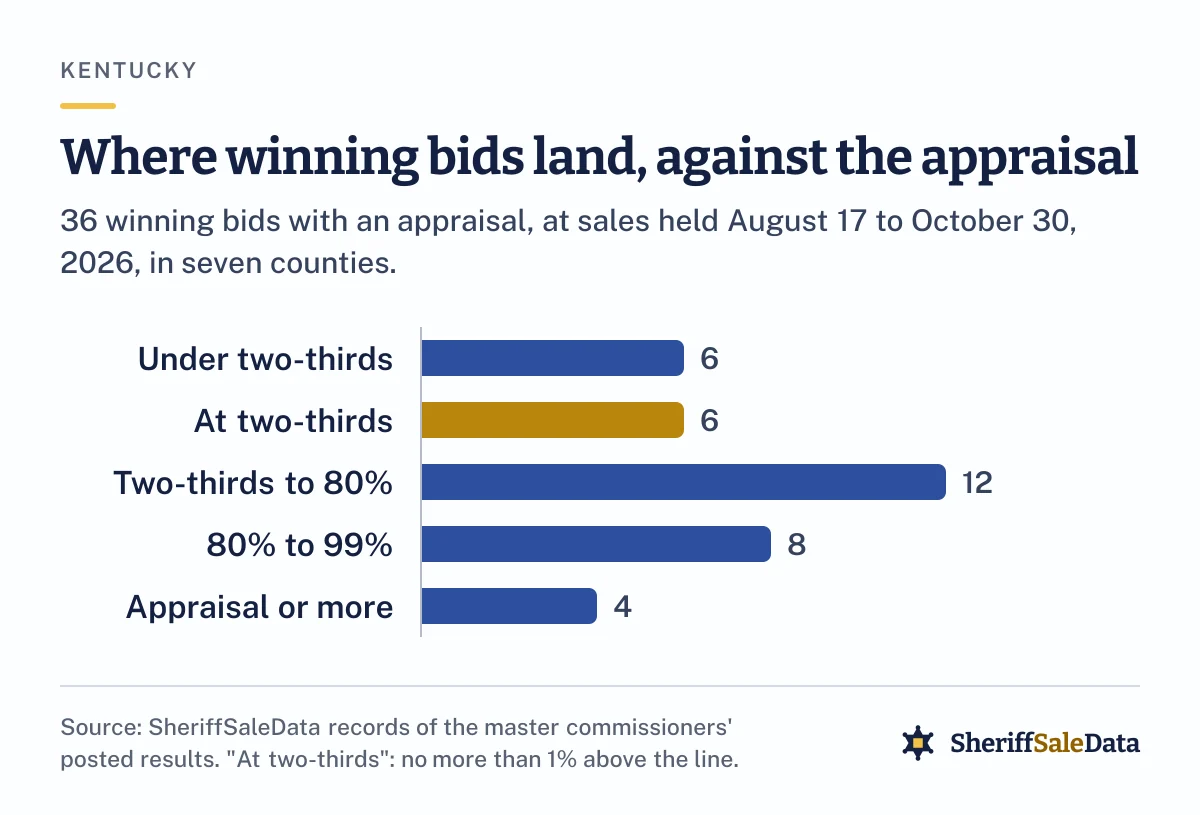
Bidders know it. In our records, winning bids gather at the line:
Terms: 10 percent down and a bond for the rest
At a Kentucky commissioner sale the winner pays in full, or pays 10 percent down and signs a bond for the balance, due in 30 days with interest at the judgment's rate. The bond needs a surety the commissioner approved before the sale.
The rule is now one sentence for the whole state: "At the time of sale the successful bidder shall either pay full cash or make a deposit of 10% of the purchase price with the balance on credit for 30 days" [35]. A bidder who does not pay in full "shall execute a bond at the time of sale with sufficient surety approved by the master commissioner prior to the sale to secure the unpaid balance of the purchase price" [36]. The bonds "shall bear interest from date at the rate the judgment bears" [37], which on a mortgage note is the note's own rate [38], so it differs from sale to sale and is printed with each one. A bond has "the force of judgments" [39], and the property carries a lien "as security for the purchase money" [40] until it is paid.
"Approved prior to the sale" is the part that catches newcomers. Offices want the surety lined up days ahead: commonly a bank's irrevocable letter of credit, or an individual surety who comes to the sale with a sworn statement of net worth well above the price. A loan commitment does not count, and a bidder without an approved bond can usually buy only by paying the whole price on the spot. Each office prints its own rules for the surety and for payment, and some take personal checks while others want certified funds, so read the terms before the sale day.
The plaintiff plays by different rules: "in lieu of the deposit the plaintiff shall be allowed to bid on credit up to the judgment amount" [41]. Yet in Kentucky outside bidders win often. Of the 28 sales in our records whose list said which side won, 17 went to a third party and 11 to the plaintiff, the reverse of Cook County, where the lender takes most properties back.
Local rules add their own terms. In Jefferson County, "If the deposit is not made immediately, the Master Commissioner shall reject the bid and resell the property forthwith" [42], bids rise in set steps [43], and the winner must insure the buildings "from the date of the sale until the purchase price is paid" [44]. In Bourbon, Scott and Woodford counties "Risk of loss shall pass to the purchaser upon execution of the bond at sale" [45]. Insure the property the day you win it, wherever it is. And a buyer who walks away pays for it: in Graves County, one who "fails to secure financing or fails to pay the purchase price for any reason" bears "all costs of the sale" [46], and elsewhere the deposit is forfeited and the property resold at the defaulting buyer's risk.
The commissioner's own fee, "3% of the final bid", with a $500 floor and an $8,500 cap [47], comes out of the proceeds as a cost of the sale [48], not on top of the bid.
After the sale: the report and confirmation
The commissioner files a report of sale within three business days. If no exceptions are filed, usually within 10 days, the court confirms the sale; until then a party can object, and a buyer who finds a title defect can ask the court to set the sale aside.
"The report of sale shall be filed by the master commissioner no later than three business days after the date of sale" [49], and it "shall state at what sum the property sold was appraised" [50]. "If the report is not excepted to, the sale may be confirmed" [32]. The waiting period is set locally and is usually 10 days: in Jefferson a buyer "may move for an order confirming the sale ten (10) or more days after the filing" of the report [51], and in the 14th Circuit, ten days after the report "if no exceptions have been filed thereto and without motion, the sale shall be deemed confirmed" [52]. For vacant and abandoned property the lienholder must seek confirmation "within twenty (20) days of the date of the sale" [53].
Use those days. Offices give the buyer about 10 days to check title, and a buyer who finds a defect that cannot be cured can file an exception and ask the court to set the sale aside and return the money. In Jefferson the buyer, not the plaintiff, files the motion to confirm.
The deed, and what comes with it
The master commissioner "shall make all conveyances of real property" the court authorizes [54], and the deed "shall not pass any right, until it has been examined and approved by the court" [55]. The commissioner must deliver it "no later than five business days after the court has confirmed the sale and approved the deed" and the price has been paid [56]. Since July 15, 2026 the buyer must record it "within five (5) business days of receipt of the deed" [57].
The deed passes "the title of all the parties to the action or proceeding" [58]. That is why the foreclosing plaintiff must state "the liens held thereon by others, making them defendants" [59]: a lienholder left out of the case keeps its lien. A junior lienholder can also sell "subject to a prior lien or liens thereon, where the debt or debts secured thereby are not yet due" [60], so some lists mark a sale as subject to a mortgage, and that mortgage stays. Where the rule is spelled out, as in the 14th Circuit, the property is sold free of the parties' interests and liens except recorded "easements and restrictions" and "such right of redemption as may exist in favor of the United States of America or the defendant(s)" [61]. The United States, if it held a junior lien, can redeem within a year, or 120 days for a tax lien [62], and a federal tax lien survives a sale it was not made a party to [63].
Taxes. Kentucky's property tax lien has "priority over any other obligation or liability for which the property is liable" [64]. Judgments normally pay the costs of the sale and then "all City and/or County real estate taxes which are past due" from the proceeds, ahead of the plaintiff [48], and leave the buyer the current year: in the 14th Circuit "The purchaser shall be required to assume and pay all taxes and assessments upon the property for the current tax year if not due and payable on the date of sale, and for all subsequent years" [65]. Some offices pay prior years only on the buyer's written claim, filed within about 10 days of the sale.
Surplus. When the property brings more than the debt, "the court shall make proper orders for the distribution of the proceeds" [66], and "The balance of the sale proceeds, if any, shall be held by the Commissioner of this Court pending further Orders of this Court" [67].
Possession
After a sale below two-thirds, the buyer gets the immediate writ of possession the statute grants [34]. After an ordinary sale, the offices' advice is consistent: the buyer has no right to possession until the sale is confirmed and the deed issued, unless the court orders otherwise, and the commissioner's office plays no part in evictions. A buyer whose occupants will not leave asks the circuit court, in the foreclosure case, for a writ of possession, which the sheriff carries out. Federal law requires "a notice to vacate to any bona fide tenant at least 90 days before the effective date of such notice" [68]. Kentucky's 2025 law letting an owner have squatters removed by a police officer [69] does not reach "a person who is a current or former tenant of the premises" [70], and is no shortcut past a court.
Where the sales are
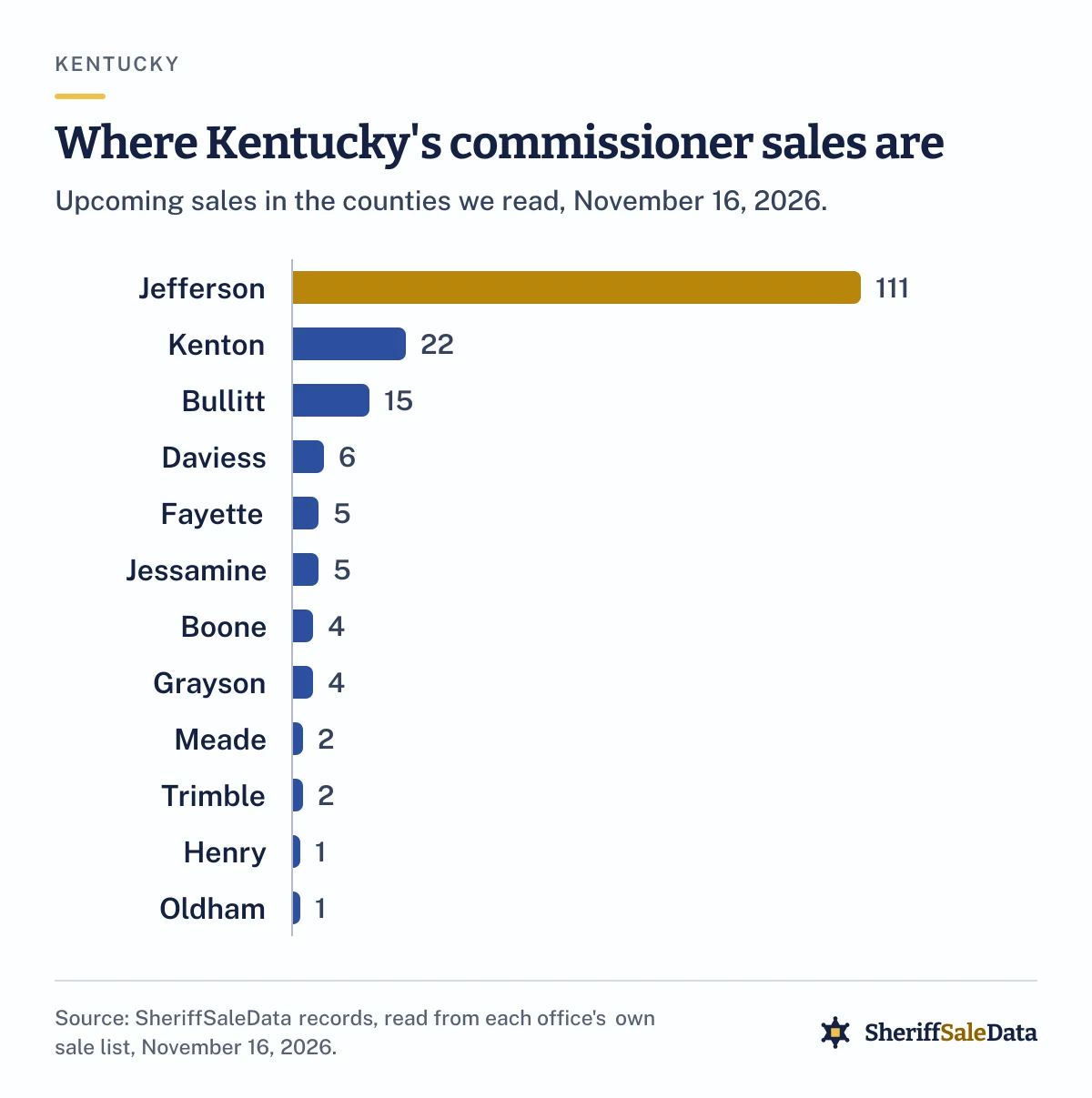
Each county's commissioner sells on a schedule of its own: some on set weekdays, some at noon, some in a courthouse lobby, and an auctioneer's sales on the property itself. Our records hold the counties below; each county's page lists its upcoming sales with the day, time and place the list prints.
A Kentucky bidder's checklist
- Find the sale on the county's list, and note the case number, the appraisal and the amount to be raised.
- Read the judgment and the appraisal in the circuit court file: who was named, what lien was foreclosed, and whether the sale is subject to a mortgage.
- Work out two-thirds of the appraisal. Below it, the owner can redeem for six months.
- Arrange the surety for your bond with the commissioner's office days before the sale, or bring the whole price.
- Check the property's tax bills, and the office's rule for claiming prior years' taxes.
- Read the office's terms for payment forms, and the judgment's rate, which your bond will carry.
- Insure the property from the moment you win, and use the days before confirmation to check title.
- After confirmation, collect the deed and record it within five business days.
The Kentucky sale lists cover every county we read, starting with Jefferson County, the busiest. The sheriff sale calendar has the dates, and how to buy at a sheriff sale covers the research before any bid. Ohio's sheriff sales use a two-thirds rule too, but as a minimum bid rather than a redemption right; the Ohio guide explains the difference.
Sources
- [1]Kentucky Court of Justice, "Master Commissioners" — Kentucky Court of Justice“Appointed by the circuit judge, they help manage judicial sales—most often involving court-ordered property sales such as foreclosures”
- [2]Ky. Rev. Stat. § 31A.010(1) — Kentucky General Assembly“A master commissioner may be appointed for each county within a judicial circuit.”
- [3]Ky. Rev. Stat. § 31A.010(1)(b) — Kentucky General Assembly“In judicial circuits with more than one (1) judge the master commissioner shall be chosen by a majority of the judges”
- [4]Ky. AP Part IV, § 2(8) (Supreme Court of Kentucky Order 2025-48, eff. Jan. 1, 2026) — Supreme Court of Kentucky“Master commissioners and deputy master commissioners shall be qualified as licensed attorneys in good standing with the Kentucky Bar Association.”
- [5]Ky. Rev. Stat. § 31A.040 — Kentucky General Assembly“the judge of the court before whom the action is pending shall appoint a special commissioner, who shall meet the same qualifications as a master commissioner”
- [6]Jefferson Circuit Court Rules of Practice (JRP) 502(A) (approved by the Supreme Court of Kentucky, eff. Jan. 1, 2022) — Jefferson Circuit Court“Unless specific provisions are made to the contrary in the judgment or order directing a sale, all judicial sales may be made by the Master Commissioner. The Sheriff shall make sales under execution or attachment.”
- [7]Ky. Rev. Stat. § 389A.030(4) — Kentucky General Assembly“If a sale of all or any part of the real estate shall be ordered, the court shall refer the matter to the master commissioner or appoint a commissioner to conduct a public sale and convey the property”
- [8]Ky. Rev. Stat. § 134.546(1) — Kentucky General Assembly (Legislative Research Commission)“may be brought at any time after the passage of one (1) year from the date the taxes became delinquent, and shall be brought within eleven (11) years of the date when the taxes became delinquent.”
- [9]Ky. Rev. Stat. § 134.546(5) — Kentucky General Assembly“If property is sold pursuant to a judgment of foreclosure, it shall be appraised pursuant to the provisions of KRS 426.520, and there shall be a right of redemption as provided in KRS 426.530.”
- [10]Ky. AP Part IV, § 1(3) (Supreme Court of Kentucky Order 2025-48, eff. Jan. 1, 2026) — Supreme Court of Kentucky“No local rules, practices, procedures, orders, or other policies of any circuit may conflict with or controvert these rules”
- [11]Ky. AP Part IV, § 4(1) (Supreme Court of Kentucky Order 2025-48, eff. Jan. 1, 2026) — Supreme Court of Kentucky“the terms and conditions of the judicial sale or estate settlement shall be established by the circuit court either in its order or rule, and in conformity with the Kentucky Revised Statutes”
- [12]Ky. Rev. Stat. § 426.005(1) — Kentucky General Assembly“In an action to enforce a mortgage or lien, judgment may be rendered for the sale of the property and for the recovery of the debt against the defendant personally.”
- [13]Ky. AP Part IV, § 5(1) (Supreme Court of Kentucky Order 2025-48, eff. Jan. 1, 2026) — Supreme Court of Kentucky“The master commissioner shall sell the property in a reasonable time not to exceed 90 days after the date of the order of referral”
- [14]Ky. AP Part IV, § 5(1) (Supreme Court of Kentucky Order 2025-48, eff. Jan. 1, 2026) — Supreme Court of Kentucky“Upon motion and good cause shown, the court may extend the deadline established by this subsection for a period not to exceed 30 days.”
- [15]Ky. Rev. Stat. § 426.205(3) — Kentucky General Assembly“If the court makes a finding in the order of sale that the property is vacant and abandoned, the master commissioner shall sell the property within seventy (70) days of the order.”
- [16]Ky. AP Part IV, § 4(5) (Supreme Court of Kentucky Order 2025-48, eff. Jan. 1, 2026) — Supreme Court of Kentucky“The master commissioner shall serve notice of the date, time and place of the judicial sale upon every party who is not in default for failure to appear.”
- [17]Ky. Rev. Stat. § 426.560 — Kentucky General Assembly“all public sales of any kind of property sold under execution, judgment or decree, shall, unless otherwise agreed upon by the parties, be advertised by publication pursuant to KRS Chapter 424. The advertisement shall state the time, place and terms of sale and describe the property to be sold.”
- [18]Ky. AP Part IV, § 5(3) (Supreme Court of Kentucky Order 2025-48, eff. Jan. 1, 2026) — Supreme Court of Kentucky“All sales shall be advertised in accordance with KRS 424.130 as follows: The advertisement shall be published at least once not less than seven days nor more than 21 days before the date of the sale”
- [19]Ky. AP Part IV, § 5(3)(c) (Supreme Court of Kentucky Order 2025-48, eff. Jan. 1, 2026) — Supreme Court of Kentucky“A description of the property to be sold, which shall include only the street address (or if the property has no street address a brief description of its location) and any number(s) assigned to the property/parcel by the tax assessor”
- [20]Ky. Rev. Stat. § 426.700 — Kentucky General Assembly“the notice of sale must state for what sum of money it is to be made”
- [21]Ky. Rev. Stat. § 426.700 — Kentucky General Assembly“Every sale made under an order of court must be public, either for cash or upon reasonable credits to be fixed by the court; and shall be made after such notice of the time, place and terms of sale as the order may direct”
- [22]Ky. Rev. Stat. § 426.700 — Kentucky General Assembly“unless the order direct otherwise, shall be made at the door of the courthouse of the county in which the property, or the greater part thereof, may be situated”
- [23]Ky. Rev. Stat. § 426.522(2) — Kentucky General Assembly“Upon the request of the creditor or mortgage holder, when property is ordered to be sold by a court, the master commissioner, as described in KRS Chapter 31A, shall employ a licensed auctioneer to handle the sale upon terms and conditions acceptable to the creditor or mortgage holder.”
- [24]Ky. Rev. Stat. § 426.522(3) — Kentucky General Assembly“If real property is sold at a public sale conducted by a licensed auctioneer, then the sale shall be conducted on the site of the real property to be sold. Notwithstanding this subsection, the sale may be conducted at another location in the county in which the real property is located if the licensed auctioneer determines that is the best site for the sale.”
- [25]Ky. Rev. Stat. § 426.522(1)(a)1. (as amended eff. July 15, 2026) — Kentucky General Assembly“Shall not exceed ten percent (10%) of the sale price on sales of real property, which may be an auction premium or commission charged to the sale of the property”
- [26]Ky. Rev. Stat. § 426.520(1) — Kentucky General Assembly“Before any real property is to be sold under an order or judgment of a court, other than an execution, the commissioner or other officer selling the property shall have it appraised, under oath, by two (2) disinterested, intelligent housekeepers of the county”
- [27]Ky. AP Part IV, § 5(2) (Supreme Court of Kentucky Order 2025-48, eff. Jan. 1, 2026) — Supreme Court of Kentucky“the appraisal value shall be determined by two disinterested persons both of whom are actively engaged in or have had at least one year of experience in the field of real estate”
- [28]Ky. Rev. Stat. § 426.520(2) — Kentucky General Assembly“Prior to the sale, the appraisal shall be filed among the papers of the cause in which the judgment was rendered or the order made, and entered on the records of the court.”
- [29]Ky. Rev. Stat. § 426.530(1) — Kentucky General Assembly“If real property sold in pursuance of a judgment or order of a court, other than an execution, does not bring two-thirds (2/3) of its appraised value, the defendant and his or her representatives may redeem it within six (6) months from the day of sale, by paying the original purchase money and ten percent (10%) per annum interest thereon”
- [30]Ky. Rev. Stat. § 426.530(1) — Kentucky General Assembly“and any reasonable costs incurred by the purchaser after the sale for maintenance or repair of the property, including but not limited to utility expenses, insurance, association fees, taxes”
- [31]Ky. Rev. Stat. § 426.530(2) — Kentucky General Assembly“The defendant shall pay the redemption money to the clerk of the court in which the judgment was rendered or the order of sale was made. Upon payment by the defendant, the master commissioner shall convey the real property to the defendant.”
- [32]Ky. Rev. Stat. § 426.540 — Kentucky General Assembly“If the report is not excepted to, the sale may be confirmed, but if the land is redeemed the confirmation shall thereafter be null and void.”
- [33]2014 Ky. Acts ch. 107 (SB 36), § 1 (amending Ky. Rev. Stat. § 426.530) — Kentucky General Assembly“may redeem it within six (6) months[a year] from the day of sale”
- [34]Ky. Rev. Stat. § 426.530(3) — Kentucky General Assembly“When the right of redemption exists, the purchaser shall receive an immediate writ of possession and a deed containing a lien in favor of the defendant, reflecting the defendant's right to redeem during the statutory period.”
- [35]Ky. AP Part IV, § 5(4) (Supreme Court of Kentucky Order 2025-48, eff. Jan. 1, 2026) — Supreme Court of Kentucky“At the time of sale the successful bidder shall either pay full cash or make a deposit of 10% of the purchase price with the balance on credit for 30 days.”
- [36]Ky. AP Part IV, § 5(4) (Supreme Court of Kentucky Order 2025-48, eff. Jan. 1, 2026) — Supreme Court of Kentucky“If the purchase price is not paid in full, the successful bidder shall execute a bond at the time of sale with sufficient surety approved by the master commissioner prior to the sale to secure the unpaid balance of the purchase price.”
- [37]Ky. Rev. Stat. § 426.705(2) — Kentucky General Assembly“They shall bear interest from date at the rate the judgment bears.”
- [38]Ky. Rev. Stat. § 360.040(3) — Kentucky General Assembly“A judgment rendered on a contract, promissory note, or other written obligation shall bear interest at the interest rate established in that contract, promissory note, or other written obligation.”
- [39]Ky. Rev. Stat. § 426.705(3) — Kentucky General Assembly“They shall have the force of judgments; and on executions issued upon them no replevy shall be allowed”
- [40]Ky. Rev. Stat. § 426.715 — Kentucky General Assembly“A lien shall exist on real property sold under an order of court, as security for the purchase money”
- [41]Ky. AP Part IV, § 5(4) (Supreme Court of Kentucky Order 2025-48, eff. Jan. 1, 2026) — Supreme Court of Kentucky“In the event the successful bidder is the plaintiff, then in lieu of the deposit the plaintiff shall be allowed to bid on credit up to the judgment amount.”
- [42]Jefferson Circuit Court Rules of Practice (JRP) 502(C) (approved by the Supreme Court of Kentucky, eff. Jan. 1, 2022) — Jefferson Circuit Court“If the deposit is not made immediately, the Master Commissioner shall reject the bid and resell the property forthwith. In making a resale, the Master Commissioner shall receive no bid from the rejected bidder.”
- [43]Jefferson Circuit Court Rules of Practice (JRP) 503 (approved by the Supreme Court of Kentucky, eff. Jan. 1, 2022) — Jefferson Circuit Court“All bids between $500 and $50,000.00 shall be increased in increments of $500.00. Bids of $50,000.00 up to $100,000.00 shall be increased in increments of $1,000.00.”
- [44]Jefferson Circuit Court Rules of Practice (JRP) 505 (approved by the Supreme Court of Kentucky, eff. Jan. 1, 2022) — Jefferson Circuit Court“the successful bidder, at the bidder's own expense, shall carry fire and extended coverage insurance on the improvements from the date of the sale until the purchase price is paid”
- [45]Local Rules of Practice, 14th Judicial Circuit (Bourbon, Scott and Woodford Circuit Courts), Rule XXV(J) (approved by the Supreme Court of Kentucky, June 14, 2022) — 14th Judicial Circuit of Kentucky“Risk of loss shall pass to the purchaser upon execution of the bond at sale or payment of the purchase price in full, whichever occurs first.”
- [46]Rules of Practice of the Graves Circuit Court (52nd Judicial Circuit), Rule 1104 (approved by the Supreme Court of Kentucky, eff. Dec. 16, 2024) — Graves Circuit Court“If the purchaser fails to secure financing or fails to pay the purchase price for any reason, then the purchaser shall be solely responsible for all costs of the sale including the Master Commissioner’s costs.”
- [47]Ky. AP Part IV, § 8(2)(a) (Supreme Court of Kentucky Order 2025-48, eff. Jan. 1, 2026) — Supreme Court of Kentucky“3% of the final bid. The fee shall be no less than $500 and shall not exceed $8,500.”
- [48]Local Rules of Practice and Procedure, 15th Judicial Circuit (Carroll, Grant and Owen Circuit Courts), App. A (sample judgment and order of sale), ¶ 8 (approved by the Supreme Court of Kentucky, Dec. 16, 2025) — 15th Judicial Circuit of Kentucky“To the costs of the sale, including all Master Commissioner’s costs; b. To the payment of all City and/or County real estate taxes which are past due; c. To the full satisfaction of the judgment in favor of the Plaintiff”
- [49]Ky. AP Part IV, § 5(5) (Supreme Court of Kentucky Order 2025-48, eff. Jan. 1, 2026) — Supreme Court of Kentucky“The report of sale shall be filed by the master commissioner no later than three business days after the date of sale.”
- [50]Ky. Rev. Stat. § 426.540 — Kentucky General Assembly“A sale made in pursuance of any such judgment or order shall be reported to the court by the commissioner or officer who made the sale, and the report shall state at what sum the property sold was appraised.”
- [51]Jefferson Circuit Court Rules of Practice (JRP) 506(A) (approved by the Supreme Court of Kentucky, eff. Jan. 1, 2022) — Jefferson Circuit Court“A successful bidder at a sale may move for an order confirming the sale ten (10) or more days after the filing of a Master Commissioner's Report of Sale.”
- [52]Local Rules of Practice, 14th Judicial Circuit (Bourbon, Scott and Woodford Circuit Courts), Rule XXV(J) (approved by the Supreme Court of Kentucky, June 14, 2022) — 14th Judicial Circuit of Kentucky“Ten (10) days after the filing of that report, if no exceptions have been filed thereto and without motion, the sale shall be deemed confirmed”
- [53]Ky. Rev. Stat. § 426.205(4) — Kentucky General Assembly“shall apply for an order confirming the sale within twenty (20) days of the date of the sale and, unless there have been exceptions to the report of the master commissioner, the court shall act on such application not later than the next regularly scheduled civil motion or rule day.”
- [54]Ky. Rev. Stat. § 426.570 — Kentucky General Assembly“Unless otherwise specially ordered by the court, the master commissioner of a Circuit Court shall make all conveyances of real property that are authorized by law to be made by a commissioner of the Circuit Court.”
- [55]Ky. Rev. Stat. § 426.575 — Kentucky General Assembly“A conveyance by a commissioner shall not pass any right, until it has been examined and approved by the court”
- [56]Ky. AP Part IV, § 5(6) (Supreme Court of Kentucky Order 2025-48, eff. Jan. 1, 2026) — Supreme Court of Kentucky“The master commissioner shall execute and deliver the deed to the purchaser of the property no later than five business days after the court has confirmed the sale and approved the deed and all costs, fees, and other required amounts due and owing, if any, have been paid by the foreclosing mortgagee or lienholder or the purchase price has been paid in full by the third party purchaser.”
- [57]Ky. Rev. Stat. § 382.110(10)(a) (eff. July 15, 2026) — Kentucky General Assembly“A deed filed pursuant to KRS 426.577 shall be filed by the grantee within five (5) business days of receipt of the deed from the commissioner appointed by a court to convey the property.”
- [58]Ky. Rev. Stat. § 426.574 — Kentucky General Assembly“A conveyance made in pursuance of a sale ordered by the court shall pass to the grantee the title of all the parties to the action or proceeding.”
- [59]Ky. Rev. Stat. § 426.006 — Kentucky General Assembly“The plaintiff in an action for enforcing a lien on property shall state in his petition the liens held thereon by others, making them defendants”
- [60]Ky. Rev. Stat. § 426.690 — Kentucky General Assembly“the holder of an inferior lien, when the debt thereby secured is due, may enforce the same by a sale of land subject to a prior lien or liens thereon, where the debt or debts secured thereby are not yet due”
- [61]Local Rules of Practice, 14th Judicial Circuit (Bourbon, Scott and Woodford Circuit Courts), Rule XXV(G)(3)(d) (approved by the Supreme Court of Kentucky, June 14, 2022) — 14th Judicial Circuit of Kentucky“The property shall otherwise be sold free and clear of any right, title or interest of all parties to the action and all liens and encumbrances thereon, except easements and restrictions of record in the County Clerk’s Office of each respective county in which the property is located, and such right of redemption as may exist in favor of the United States of America or the defendant(s).”
- [62]28 U.S.C. § 2410(c) — United States Congress“Where a sale of real estate is made to satisfy a lien prior to that of the United States, the United States shall have one year from the date of sale within which to redeem, except that with respect to a lien arising under the internal revenue laws the period shall be 120 days or the period allowable for redemption under State law, whichever is longer”
- [63]26 U.S.C. § 7425(a)(1) — United States Congress“shall be made subject to and without disturbing the lien of the United States, if notice of such lien has been filed in the place provided by law for such filing at the time such action or suit is commenced”
- [64]Ky. Rev. Stat. § 134.420(3) — Kentucky General Assembly“and shall have priority over any other obligation or liability for which the property is liable”
- [65]Local Rules of Practice, 14th Judicial Circuit (Bourbon, Scott and Woodford Circuit Courts), Rule XXV(G)(3)(c) (approved by the Supreme Court of Kentucky, June 14, 2022) — 14th Judicial Circuit of Kentucky“The purchaser shall be required to assume and pay all taxes and assessments upon the property for the current tax year if not due and payable on the date of sale, and for all subsequent years. All currently due and delinquent taxes and assessments upon the property as of the date of sale shall be paid from the sale proceeds.”
- [66]Ky. Rev. Stat. § 426.685(2) — Kentucky General Assembly“the officer shall sell the whole of it, though it bring more than the sum to be raised, and the court shall make proper orders for the distribution of the proceeds.”
- [67]Local Rules of Practice and Procedure, 15th Judicial Circuit (Carroll, Grant and Owen Circuit Courts), App. A (sample judgment and order of sale), ¶ 8 (approved by the Supreme Court of Kentucky, Dec. 16, 2025) — 15th Judicial Circuit of Kentucky“The balance of the sale proceeds, if any, shall be held by the Commissioner of this Court pending further Orders of this Court.”
- [68]Protecting Tenants at Foreclosure Act, Pub. L. 111-22 § 702 (12 U.S.C. § 5220 note) — United States Congress“the provision, by such successor in interest of a notice to vacate to any bona fide tenant at least 90 days before the effective date of such notice”
- [69]Ky. Rev. Stat. § 383.290(2) — Kentucky General Assembly“A property owner or his or her authorized agent may request a law enforcement officer to immediately remove a person or persons unlawfully occupying real property”
- [70]Ky. Rev. Stat. § 383.290(9) — Kentucky General Assembly“The procedures established in this section are not applicable to, and shall not be enforced against, a person who is a current or former tenant of the premises or who once had an agreement with the property owner that permitted the person to occupy the premises.”
Questions
What is a master commissioner sale?
Kentucky's court-ordered sale of real estate, most often a foreclosure, also partitions of co-owned land and foreclosures of delinquent-tax certificates. It is run by the circuit court's master commissioner, an attorney appointed by the circuit judges, rather than by the sheriff, who sells property under an execution or attachment. Each county's office holds its own sales, usually at the courthouse.
How does a master commissioner sale work in Kentucky?
The court enters a judgment ordering the property sold and refers it to the commissioner, who must sell within 90 days. Two appraisers value the property and the appraisal is filed in the case. The sale is advertised 7 to 21 days ahead and held as a public auction. The winner pays in full or puts 10 percent down and signs a bond for the rest, due in 30 days. The commissioner reports the sale within three business days, the court confirms it if no one objects, and the commissioner delivers the deed.
What is the two-thirds rule in Kentucky?
If a property sells for less than two-thirds of its appraised value, the defendant and the defendant's representatives can redeem it within six months of the sale by paying the price, 10 percent a year interest and the buyer's reasonable costs of upkeep. The buyer still gets possession and a deed, but the deed carries a lien for that right. Bidding at least two-thirds of the appraisal avoids it.
How much money do you need to bid at a master commissioner sale?
Either the full price or 10 percent of it at the sale, with the balance due in 30 days on a bond. The bond needs a surety the commissioner approved before the sale: many offices accept a bank's letter of credit or an individual surety with a sworn statement of net worth, and a bidder without an approved bond usually has to pay the whole price on the spot. Payment forms differ by county, so read the office's terms first.
Can the owner get the house back after a master commissioner sale?
Only in narrow cases. If the price was below two-thirds of the appraisal, the defendant can redeem within six months. If the United States held a junior lien, it can redeem within a year, or 120 days for a federal tax lien. Otherwise the owner's chance ends with the sale, unless the court sets the sale aside before confirming it.
When does the buyer get possession after a master commissioner sale?
After a sale below two-thirds of the appraisal the law gives the buyer an immediate writ of possession. After an ordinary sale, offices advise that possession comes with confirmation and the deed unless the court orders otherwise, and a buyer whose occupants will not leave asks the circuit court in the same case for a writ of possession. A bona fide tenant is entitled under federal law to 90 days' notice.
Who pays the property taxes at a master commissioner sale?
Taxes that are past due at the sale are normally paid from the proceeds under the court's judgment, and the buyer takes on the current year's taxes and every later year. Some offices pay prior years only if the buyer files a written claim within a set time, usually 10 days, so read the terms and the ad for the sale you want.
Where are master commissioner sales held?
Each circuit court's commissioner holds sales for its own county, usually at the courthouse or judicial center, on a day and hour of the office's choosing; a sale run by an auctioneer at the lender's request is held on the property itself. Our Kentucky pages list each county we read with its upcoming sales, including Jefferson (Louisville), Kenton (Covington), Fayette (Lexington) and Bullitt.
Where next
- Sheriff sale calendarEvery county's upcoming sale days, with property counts and start times.
- Sheriff sale guidesHow a sheriff sale works, how to bid, and the rules for Florida, Illinois, Kentucky, New Jersey, Ohio, Pennsylvania and Philadelphia.
- Foreclosing lendersThe banks, servicers and trusts bringing sheriff sales, with every county they foreclose in.
- Sheriff sale glossaryUpset price, writ of execution, adjournment, credit bid — every term a listing uses.
General information about Kentucky procedure, not legal advice. Each master commissioner sets the terms of sale under the court's judgment, and statutes change; confirm with the commissioner's office before bidding.